









Dernière mise à jour le 04/09/2025 par Usine de solénoïdes
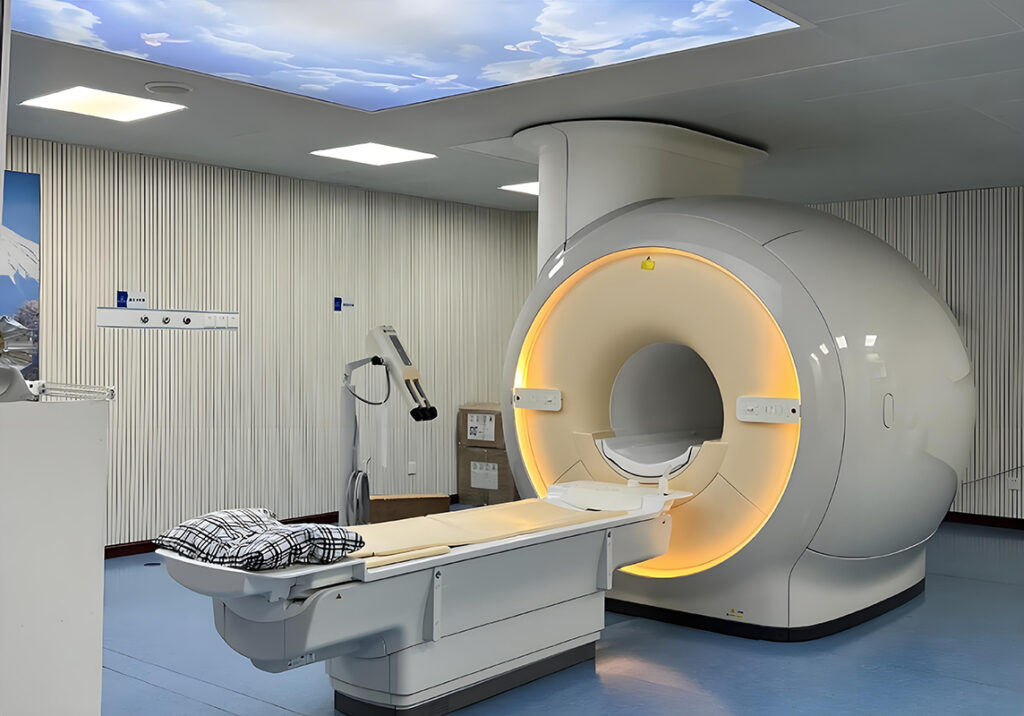
Magnetic Resonance Imaging (MRI) has revolutionized diagnostic medicine by providing unparalleled insights into the human body’s soft tissues, organs, and vascular systems. At the core of this technology lies a marvel of engineering: électroaimants. These devices generate and control the powerful, stable magnetic fields essential for high-resolution imaging. As a professional electromagnet manufacturer, we explore the critical role of electromagnets in MRI systems, the technical challenges of magnetic field control, and the innovations driving the future of medical imaging.
1. The Role of Electromagnets in MRI Magnetic Field Generation
1.1 The Basics of MRI Operation
MRI works by aligning hydrogen nuclei in the body’s water molecules using a strong magnetic field. Radiofrequency (RF) pulses temporarily disrupt this alignment, and the energy released as nuclei return to their original state is detected and converted into detailed images. The strength and stability of the magnetic field directly determine image quality, making electromagnets indispensable.
1.2 Types of Electromagnets in MRI Systems
- Superconducting Electromagnets: The gold standard for clinical MRI, these coils operate at cryogenic temperatures (near absolute zero) to achieve zero electrical resistance, enabling ultra-high field strengths (1.5 Tesla to 7 Tesla and beyond).
- Resistive Electromagnets: Use standard conductive materials (e.g., copper) but require continuous power and cooling, limiting them to low-field MRI systems (under 0.5 Tesla).
- Permanent Magnets: Rare-earth magnets (e.g., neodymium) provide static fields but lack adjustability, making them less common in advanced MRI.
1.3 Key Components of MRI Electromagnets
- Coils: Wound from superconducting wire (e.g., niobium-titanium) to carry high currents.
- Cryostat: A vacuum-insulated chamber filled with liquid helium to maintain superconductivity.
- Shim Coils: Smaller electromagnets that fine-tune field homogeneity.
- Gradient Coils: Rapidly switchable coils that create spatial encoding fields for image reconstruction.
2. Magnetic Field Control: Precision Engineering Challenges
2.1 Achieving Field Homogeneity
Défi: Even minor inhomogeneities in the magnetic field distort images. For example, a variation of just 0.1 parts per million (ppm) over a 50 cm sphere is required for high-resolution brain imaging.
Solution:
- Active Shimming: Adjustable shim coils counteract field distortions in real time.
- Passive Shimming: Ferromagnetic materials are strategically placed around the bore to correct static inhomogeneities.
2.2 Maintaining Field Stability
Défi: External factors (e.g., moving metal objects, power fluctuations) disrupt the magnetic field.
Solution:
- Shielded Rooms: MRI suites are encased in Faraday cages and ferromagnetic shielding to block external interference.
- Feedback Systems: Monitor field strength and adjust coil currents dynamically.
2.3 Managing Heat and Energy
Défi: Superconducting coils require extreme cooling, while resistive systems generate significant heat.
Solution:
- Liquid Helium Cooling: Maintains superconducting coils at 4.2 K (-269°C).
- Energy-Efficient Designs: New superconducting materials (e.g., MgB₂) operate at higher temperatures (up to 20 K), reducing reliance on liquid helium.
3. Applications of Electromagnets in MRI Systems
3.1 High-Field MRI (1.5T to 7T)
High-field MRI systems rely on superconducting électroaimants to achieve detailed images of the brain, spinal cord, and musculoskeletal system. These systems excel in detecting tumors, strokes, and neurodegenerative diseases.
Étude de cas : A 7T MRI scanner, powered by advanced superconducting coils, revealed microscopic brain lesions in multiple sclerosis patients that were invisible at lower field strengths.
3.2 Functional MRI (fMRI)
fMRI tracks brain activity by detecting blood oxygenation changes. Ultra-stable electromagnets ensure minimal noise during prolonged scans, enabling research into cognition, emotion, and neurological disorders.
3.3 Interventional MRI
Electromagnets enable real-time imaging during surgeries. Open-bore MRI systems with adjustable fields allow surgeons to operate while monitoring progress, improving outcomes in tumor resections and biopsies.
3.4 Portable and Low-Field MRI
Advances in resistive electromagnets and permanent magnet designs have led to compact, low-field MRI systems for emergency rooms, rural clinics, and battlefield medicine. These systems trade some resolution for accessibility and cost-effectiveness.

4. Technical Innovations in MRI Electromagnets
4.1 High-Temperature Superconductors (HTS)
HTS materials like rare-earth barium copper oxide (ReBCO) can operate at higher temperatures (77 K), simplifying cooling systems and reducing helium consumption. HTS coils also tolerate higher magnetic fields, paving the way for 10T+ MRI systems.
4.2 Hybrid Magnet Systems
Combining superconducting and resistive electromagnets allows adjustable field strengths, optimizing imaging for specific applications (e.g., cardiac vs. neurological scans).
4.3 AI-Driven Field Optimization
Machine learning algorithms analyze historical scan data to predict and correct field inhomogeneities, reducing setup times and improving image consistency.
4.4 Sustainable Cooling Solutions
- Helium Reclamation Systems: Capture and recycle evaporated helium, addressing global supply shortages.
- Cryogen-Free MRI: Use cryocoolers to eliminate liquid helium dependency, as seen in some next-generation scanners.
4.5 Lightweight and Flexible Coils
3D-printed gradient coils and flexible superconducting tapes enable novel MRI designs, such as wearable scanners for joint imaging or neonatal care.
5. Challenges in Electromagnet Design for MRI
5.1 Material Limitations
Défi: Superconducting wires are brittle and difficult to shape into complex coil geometries.
Solution: Development of flexible superconducting tapes and additive manufacturing techniques for custom coils.
5.2 Cost and Accessibility
Défi: High costs of superconducting materials and helium limit MRI availability in developing regions.
Solution: Low-field resistive systems and HTS magnets that reduce operational expenses.
5.3 Patient Safety
Défi: Strong magnetic fields pose risks (e.g., projectile effects, implant heating).
Solution: Rigorous safety protocols, ferromagnetic detectors, and “quench” systems to safely dissipate magnetic energy in emergencies.
5.4 Regulatory Compliance
Défi: Meeting stringent medical device standards (e.g., FDA, CE) for electromagnetic compatibility (EMC) and patient exposure.
Solution: Advanced shielding and real-time monitoring systems to ensure compliance.
6. The Future of Electromagnets in MRI
6.1 Ultra-High-Field MRI (10T and Beyond)
Researchers are developing 10T+ MRI systems to visualize cellular-level structures. These require breakthroughs in superconducting materials and quench management to handle immense magnetic energies.
6.2 Quantum-Enhanced MRI
Quantum sensors, such as superconducting quantum interference devices (SQUIDs), could work with electromagnets to detect weak magnetic signals, enabling MRI at ultra-low fields with minimal infrastructure.
6.3 Integrated Multimodal Imaging
Combining MRI with PET, CT, or ultrasound in hybrid systems will demand electromagnets that operate harmoniously with other imaging technologies.
6.4 AI and Autonomous MRI
Autonomous MRI systems will use AI to adjust field parameters in real time, optimizing scans for individual patient anatomy and reducing operator dependency.
6.5 Global Democratization of MRI
Affordable, portable MRI systems powered by advanced electromagnets will expand access to life-saving diagnostics in low-resource settings.
Electromagnets—The Unsung Heroes of Medical Imaging
électroaimants are the invisible force behind MRI’s transformative power in healthcare. From enabling early disease detection to guiding complex surgeries, their role in magnetic field control is nothing short of revolutionary. As technology advances, the collaboration between electromagnet manufacturers, medical researchers, and clinicians will continue to push the boundaries of what’s possible in diagnostic imaging.
For healthcare providers and researchers, understanding the intricacies of MRI electromagnets is key to leveraging their full potential. For manufacturers, innovation in materials, cooling, and AI integration will drive the next era of MRI—one where precision, accessibility, and sustainability redefine patient care worldwide.
In the quest to see deeper, clearer, and farther into the human body, electromagnets remain at the forefront, proving that even the most powerful forces in medicine can be harnessed with elegance and precision.
À propos de l'usine d'électroaimants SF
Shengfeng Electromagnet Co., Ltd., fondée en 2015, est située dans le parc industriel de Xiansha, bénéficiant d'un cadre agréable et d'une excellente desserte. L'entreprise s'étend sur 16 000 mètres carrés et dispose d'usines de production modernes, d'équipements de pointe et d'une équipe technique hautement qualifiée. Depuis sa création, elle s'est toujours attachée à sa philosophie d'entreprise axée sur l'innovation, la qualité et le service, en se concentrant sur la recherche, le développement et la production de… électroaimants, en promouvant constamment les mises à jour de produits et les progrès technologiques, et en fournissant aux clients des produits et services de la meilleure qualité.
Pourquoi choisir un électroaimant SF ?
HAUTE QUALITÉ :En tant que premier fabricant d'électroaimants à solénoïde en Chine, notre équipe de contrôle qualité veille à ce que chaque produit que vous recevez soit d'une qualité irréprochable. Nous disposons d'équipements professionnels pour les tests de qualité.
CONCEPTION DU PRODUIT :Notre service d'échantillonnage maîtrise l'ensemble du processus de concrétisation de vos plans. Nous optimisons également la conception de vos produits en nous appuyant sur nos années d'expérience. Faites-nous part de vos avis.
DÉLAI DE LIVRAISON STABLE :En tant que fabricant et fournisseur d'électroaimants de premier plan, nous disposons d'une capacité de production suffisante ; les commandes importantes ne nous effraient pas et nous sommes en mesure de les livrer dans les délais.
MEILLEUR PRIX :Nous sommes une usine d'origine spécialisée dans les électroaimants et le meilleur fabricant de solénoïdes en Chine ; c'est pourquoi nous pouvons proposer des produits de haute qualité au meilleur prix.
GESTION PRÉCISE :Rien ne peut être accompli sans une gestion rigoureuse. Nous sommes une entreprise dotée d'un système de gestion complet.
SERVICE 7-24 :En tant que fabricant leader de solénoïdes, nous vous garantissons une réponse immédiate 24h/24 et 7j/7 : vos commentaires nous permettent de nous améliorer constamment. Contactez-nous. WhatsApp +86 18902611680
FAQ sur les électroaimants
Nous sommes un leader chinois électro-aimant Notre usine de fabrication est située à Dongguan. Nous serions ravis de vous accueillir !
Nous sommes spécialisés dans la conception et la production de produits de haute qualité. électro-aimant,électrovanne,tel que solénoïde rotatif, solénoïdes bistables, solénoïdes de verrouillage, solénoïdes à cadre ouvert, solénoïdes tubulaires, solénoïde auto-maintenu
Bien entendu, nous fournissons généralement des échantillons gratuits ; vous n’avez qu’à prendre en charge les frais de port. Pour les échantillons d’électroaimants sur mesure, veuillez nous communiquer vos exigences afin que nous puissions vous indiquer le coût de l’échantillon.
• La production d'un échantillon prend environ 7 jours.
Oui, nous proposons des services de conception gratuits, incluant la conception structurelle et la conception graphique simple.
Bien sûr. Nous pouvons fabriquer n'importe quel électroaimant selon votre conception. Nous proposons désormais un service ODM de solénoïdes pour les petites séries (de 100 à 500 pièces), avec la possibilité d'y apposer votre logo.
En fonction de la quantité commandée et des détails de production, cela prendra environ 15 à 20 jours.
Toujours un échantillon de préproduction avant la production en série ; toujours une inspection finale avant l'expédition
• Puissance, consommation, dimensions, matériau, quantité, destination de livraison, etc.
• Vous pouvez aussi simplement nous faire part de vos besoins et nous vous recommanderons des produits.
• Par mer, par air ou par transport express.
• Si vous avez votre propre transitaire en Chine, il s'agit du prix départ usine ou FOB.
•CFR ou CIF, etc., si vous avez besoin que nous expédiions en votre nom.
• Le DDP et le DDU peuvent également être utilisés.
• Plus de choix, nous prendrons en compte vos choix.
Le prix est déterminé par la quantité, le matériau, le procédé de fabrication, la taille et d'autres facteurs. De plus, grâce à notre croissance continue, nous proposons des tarifs compétitifs.
Grâce à l'innovation technologique, les prix de certains de nos produits sont extrêmement compétitifs ; veuillez nous contacter pour obtenir un devis.