









Zuletzt aktualisiert am 04.09.2025 von Magnetspulenfabrik
Magnetic Resonance Imaging (MRI) has revolutionized diagnostic medicine by providing unparalleled insights into the human body’s soft tissues, organs, and vascular systems. At the core of this technology lies a marvel of engineering: Elektromagnete. These devices generate and control the powerful, stable magnetic fields essential for high-resolution imaging. As a professional electromagnet manufacturer, we explore the critical role of electromagnets in MRI systems, the technical challenges of magnetic field control, and the innovations driving the future of medical imaging.
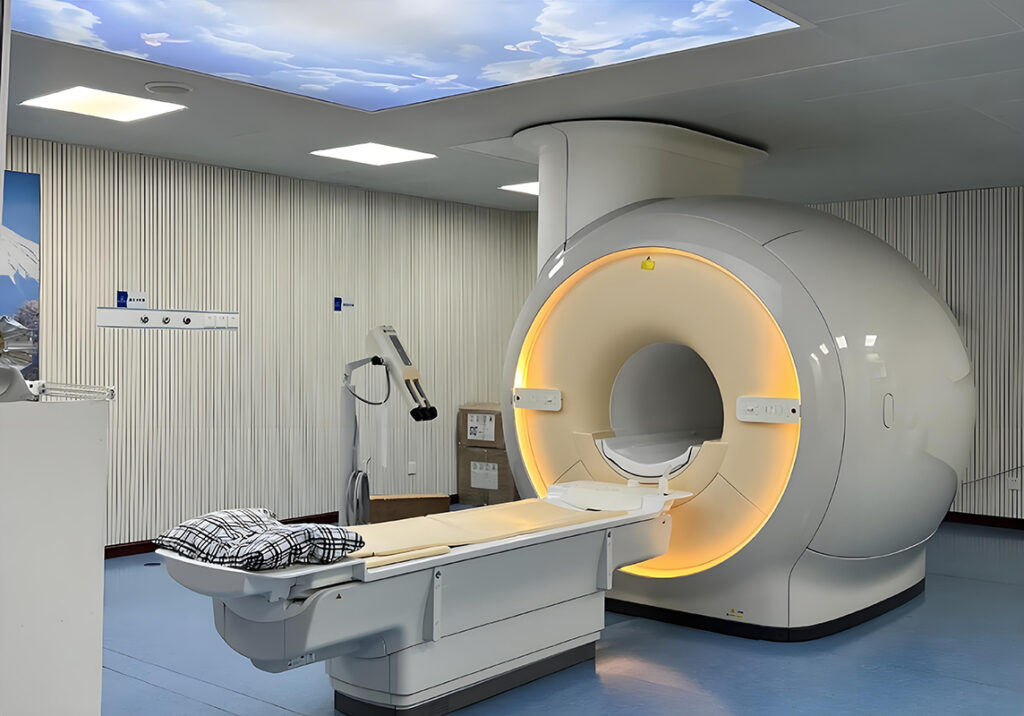
1. The Role of Electromagnets in MRI Magnetic Field Generation
1.1 The Basics of MRI Operation
MRI works by aligning hydrogen nuclei in the body’s water molecules using a strong magnetic field. Radiofrequency (RF) pulses temporarily disrupt this alignment, and the energy released as nuclei return to their original state is detected and converted into detailed images. The strength and stability of the magnetic field directly determine image quality, making electromagnets indispensable.
1.2 Types of Electromagnets in MRI Systems
- Superconducting Electromagnets: The gold standard for clinical MRI, these coils operate at cryogenic temperatures (near absolute zero) to achieve zero electrical resistance, enabling ultra-high field strengths (1.5 Tesla to 7 Tesla and beyond).
- Resistive Electromagnets: Use standard conductive materials (e.g., copper) but require continuous power and cooling, limiting them to low-field MRI systems (under 0.5 Tesla).
- Permanent Magnets: Rare-earth magnets (e.g., neodymium) provide static fields but lack adjustability, making them less common in advanced MRI.
1.3 Key Components of MRI Electromagnets
- Coils: Wound from superconducting wire (e.g., niobium-titanium) to carry high currents.
- Cryostat: A vacuum-insulated chamber filled with liquid helium to maintain superconductivity.
- Shim Coils: Smaller electromagnets that fine-tune field homogeneity.
- Gradient Coils: Rapidly switchable coils that create spatial encoding fields for image reconstruction.
2. Magnetic Field Control: Precision Engineering Challenges
2.1 Achieving Field Homogeneity
Challenge: Even minor inhomogeneities in the magnetic field distort images. For example, a variation of just 0.1 parts per million (ppm) over a 50 cm sphere is required for high-resolution brain imaging.
Solution:
- Active Shimming: Adjustable shim coils counteract field distortions in real time.
- Passive Shimming: Ferromagnetic materials are strategically placed around the bore to correct static inhomogeneities.
2.2 Maintaining Field Stability
Challenge: External factors (e.g., moving metal objects, power fluctuations) disrupt the magnetic field.
Solution:
- Shielded Rooms: MRI suites are encased in Faraday cages and ferromagnetic shielding to block external interference.
- Feedback Systems: Monitor field strength and adjust coil currents dynamically.
2.3 Managing Heat and Energy
Challenge: Superconducting coils require extreme cooling, while resistive systems generate significant heat.
Solution:
- Liquid Helium Cooling: Maintains superconducting coils at 4.2 K (-269°C).
- Energy-Efficient Designs: New superconducting materials (e.g., MgB₂) operate at higher temperatures (up to 20 K), reducing reliance on liquid helium.
3. Applications of Electromagnets in MRI Systems
3.1 High-Field MRI (1.5T to 7T)
High-field MRI systems rely on superconducting Elektromagnete to achieve detailed images of the brain, spinal cord, and musculoskeletal system. These systems excel in detecting tumors, strokes, and neurodegenerative diseases.
Case Study: A 7T MRI scanner, powered by advanced superconducting coils, revealed microscopic brain lesions in multiple sclerosis patients that were invisible at lower field strengths.
3.2 Functional MRI (fMRI)
fMRI tracks brain activity by detecting blood oxygenation changes. Ultra-stable electromagnets ensure minimal noise during prolonged scans, enabling research into cognition, emotion, and neurological disorders.
3.3 Interventional MRI
Electromagnets enable real-time imaging during surgeries. Open-bore MRI systems with adjustable fields allow surgeons to operate while monitoring progress, improving outcomes in tumor resections and biopsies.
3.4 Portable and Low-Field MRI
Advances in resistive electromagnets and permanent magnet designs have led to compact, low-field MRI systems for emergency rooms, rural clinics, and battlefield medicine. These systems trade some resolution for accessibility and cost-effectiveness.
- Bewertet mit 0 von 5
- Bewertet mit 0 von 5
- Bewertet mit 0 von 5
- Bewertet mit 0 von 5

4. Technical Innovations in MRI Electromagnets
4.1 High-Temperature Superconductors (HTS)
HTS materials like rare-earth barium copper oxide (ReBCO) can operate at higher temperatures (77 K), simplifying cooling systems and reducing helium consumption. HTS coils also tolerate higher magnetic fields, paving the way for 10T+ MRI systems.
4.2 Hybrid Magnet Systems
Combining superconducting and resistive electromagnets allows adjustable field strengths, optimizing imaging for specific applications (e.g., cardiac vs. neurological scans).
4.3 AI-Driven Field Optimization
Machine learning algorithms analyze historical scan data to predict and correct field inhomogeneities, reducing setup times and improving image consistency.
4.4 Sustainable Cooling Solutions
- Helium Reclamation Systems: Capture and recycle evaporated helium, addressing global supply shortages.
- Cryogen-Free MRI: Use cryocoolers to eliminate liquid helium dependency, as seen in some next-generation scanners.
4.5 Lightweight and Flexible Coils
3D-printed gradient coils and flexible superconducting tapes enable novel MRI designs, such as wearable scanners for joint imaging or neonatal care.
5. Challenges in Electromagnet Design for MRI
5.1 Material Limitations
Challenge: Superconducting wires are brittle and difficult to shape into complex coil geometries.
Solution: Development of flexible superconducting tapes and additive manufacturing techniques for custom coils.
5.2 Cost and Accessibility
Challenge: High costs of superconducting materials and helium limit MRI availability in developing regions.
Solution: Low-field resistive systems and HTS magnets that reduce operational expenses.
5.3 Patient Safety
Challenge: Strong magnetic fields pose risks (e.g., projectile effects, implant heating).
Solution: Rigorous safety protocols, ferromagnetic detectors, and “quench” systems to safely dissipate magnetic energy in emergencies.
5.4 Regulatory Compliance
Challenge: Meeting stringent medical device standards (e.g., FDA, CE) for electromagnetic compatibility (EMC) and patient exposure.
Solution: Advanced shielding and real-time monitoring systems to ensure compliance.
6. The Future of Electromagnets in MRI
6.1 Ultra-High-Field MRI (10T and Beyond)
Researchers are developing 10T+ MRI systems to visualize cellular-level structures. These require breakthroughs in superconducting materials and quench management to handle immense magnetic energies.
6.2 Quantum-Enhanced MRI
Quantum sensors, such as superconducting quantum interference devices (SQUIDs), could work with electromagnets to detect weak magnetic signals, enabling MRI at ultra-low fields with minimal infrastructure.
6.3 Integrated Multimodal Imaging
Combining MRI with PET, CT, or ultrasound in hybrid systems will demand electromagnets that operate harmoniously with other imaging technologies.
6.4 AI and Autonomous MRI
Autonomous MRI systems will use AI to adjust field parameters in real time, optimizing scans for individual patient anatomy and reducing operator dependency.
6.5 Global Democratization of MRI
Affordable, portable MRI systems powered by advanced electromagnets will expand access to life-saving diagnostics in low-resource settings.
Electromagnets—The Unsung Heroes of Medical Imaging
Elektromagnete are the invisible force behind MRI’s transformative power in healthcare. From enabling early disease detection to guiding complex surgeries, their role in magnetic field control is nothing short of revolutionary. As technology advances, the collaboration between electromagnet manufacturers, medical researchers, and clinicians will continue to push the boundaries of what’s possible in diagnostic imaging.
For healthcare providers and researchers, understanding the intricacies of MRI electromagnets is key to leveraging their full potential. For manufacturers, innovation in materials, cooling, and AI integration will drive the next era of MRI—one where precision, accessibility, and sustainability redefine patient care worldwide.
In the quest to see deeper, clearer, and farther into the human body, electromagnets remain at the forefront, proving that even the most powerful forces in medicine can be harnessed with elegance and precision.
Über die SF-Elektromagnetfabrik
Shengfeng Electromagnet Co., Ltd. wurde 2015 gegründet und befindet sich im Industriepark Xiansha, der durch seine landschaftliche Schönheit und die hervorragende Verkehrsanbindung besticht. Das Unternehmen erstreckt sich über eine Fläche von 16.000 Quadratmetern und verfügt über moderne Produktionsanlagen, fortschrittliche Fertigungstechnik und ein hochqualifiziertes technisches Team. Seit unserer Gründung verfolgen wir konsequent die Unternehmensphilosophie “Innovation, Qualität und Service” und konzentrieren uns auf Forschung, Entwicklung und Produktion. Elektromagnete, Wir fördern ständig Produktverbesserungen und technologischen Fortschritt und bieten unseren Kunden Produkte und Dienstleistungen von höchster Qualität.
Warum sollte man sich für einen SF-Elektromagneten entscheiden?
HOHE QUALITÄT:Als führender Hersteller von Elektromagneten in China stellt unser Qualitätssicherungsteam sicher, dass jedes einzelne Produkt, das Sie erhalten, von höchster Qualität ist. Wir verfügen über professionelle Prüfgeräte für die Qualitätskontrolle.
PRODUKTDESIGN:Unsere Musterabteilung deckt den gesamten Prozess von der Zeichnung bis zur Realisierung ab. Zudem optimieren wir Ihr Produktdesign auf der Grundlage unserer langjährigen Erfahrung. Teilen Sie uns Ihre Meinung mit.
STABILE LIEFERZEIT:Als führender Hersteller und Lieferant von Elektromagneten verfügen wir über ausreichende Fertigungskapazitäten; auch Großaufträge stellen für uns kein Problem dar – wir liefern Ihre Bestellung pünktlich.
BESTER PREIS:Wir sind ein direkt produzierendes Werk für Elektromagnete und der führende Hersteller von Solenoiden in China; deshalb können wir hochwertige Produkte zu besten Preisen anbieten.
PRÄZISES MANAGEMENT:Ohne eine präzise Steuerung lässt sich nichts erreichen. Wir sind ein Unternehmen mit einem umfassenden Managementsystem.
24-Stunden-Service:Als führender Hersteller von Magnetventilen bieten wir Ihnen rund um die Uhr sofortige Hilfe: Wir freuen uns über Ihr Feedback, um uns stetig zu verbessern. Kontaktieren Sie uns. WhatsApp +86 18902611680
Häufig gestellte Fragen zu Elektromagneten
Wir sind ein chinesisches Top-Unternehmen Elektromagnet Der Hersteller und unser Werk befinden sich in Dongguan. Besuchen Sie uns gerne!
Wir sind spezialisiert auf die Entwicklung und Produktion von hochwertigen Produkten. Elektromagnet,Magnetventil,wie zum Beispiel Drehmagnet, bistabile Magnetspulen, Verriegelungsmagnete, offene Rahmenmagnete, Rohrmagnete, selbsthaltender Magnet
• Selbstverständlich stellen wir Ihnen in der Regel kostenlose Muster zur Verfügung; Sie müssen lediglich die Versandkosten übernehmen. Für kundenspezifische Elektromagnetmuster senden Sie uns bitte Ihre Anforderungen, damit wir die Musterkosten prüfen können.
• Die Anfertigung von Mustern dauert etwa 7 Tage.
Ja, wir bieten kostenlose Designleistungen, Strukturplanung und einfache Grafikgestaltung an.
Selbstverständlich. Wir können jeden Elektromagneten nach Ihren Vorgaben fertigen. Neu im Angebot ist die ODM-Solenoidproduktion für Kleinserien von 100 bis 500 Stück. Auch hier können Sie Ihr eigenes Logo verwenden.
Je nach Bestellmenge und Produktionsdetails dauert es etwa 15 bis 20 Tage.
Vor der Serienproduktion wird stets ein Vorserienmuster gefertigt; vor dem Versand erfolgt stets eine Endkontrolle.
• Leistung, Verwendungszweck, Größe, Material, Menge, Lieferort usw.
• Sie können uns auch einfach Ihre Anforderungen mitteilen, und wir werden Ihnen Produkte empfehlen.
• Auf dem Seeweg, auf dem Luftweg oder per Express.
• Wenn Sie einen eigenen Spediteur in China haben, gilt der Preis ab Werk (FOB).
•CFR oder CIF usw., falls Sie den Versand durch uns in Ihrem Namen wünschen.
• DDP und DDU können ebenfalls verwendet werden.
• Mehr Auswahlmöglichkeiten, wir werden Ihre Wünsche berücksichtigen.
Der Preis richtet sich nach Menge, Material, Verarbeitungsmethode, Größe und weiteren Faktoren. Darüber hinaus trägt unsere kontinuierliche
Aufgrund technologischer Innovationen sind die Preise einiger unserer Produkte äußerst wettbewerbsfähig. Bitte kontaktieren Sie uns für ein Angebot.