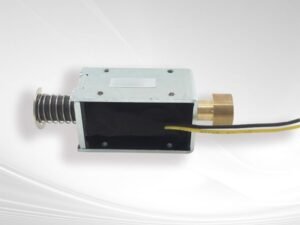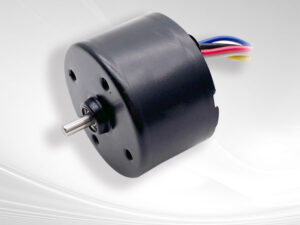










A Hersteller von Magnetventilen is not simply a supplier of coils, plungers, and metal housings. For demanding OEM applications, a professional solenoid manufacturer must understand electromagnetic principles, magnetic-circuit design, mechanical tolerances, thermal behavior, force-stroke characteristics, electrical requirements, manufacturing processes, and application integration.
A solenoid converts electrical energy into controlled mechanical movement. Depending on its construction, it can provide linear pulling or pushing motion, rotary movement, latching, holding, switching, locking, or fluid-control functions. This makes solenoids essential components in automation equipment, smart locks, household appliances, automotive systems, medical devices, industrial machinery, vending equipment, and many other products.
When selecting a Hersteller von Magnetventilen, OEM buyers should therefore evaluate much more than price. The right partner should be capable of turning application requirements into a manufacturable electromagnetic solution and maintaining consistent performance from prototype through mass production.
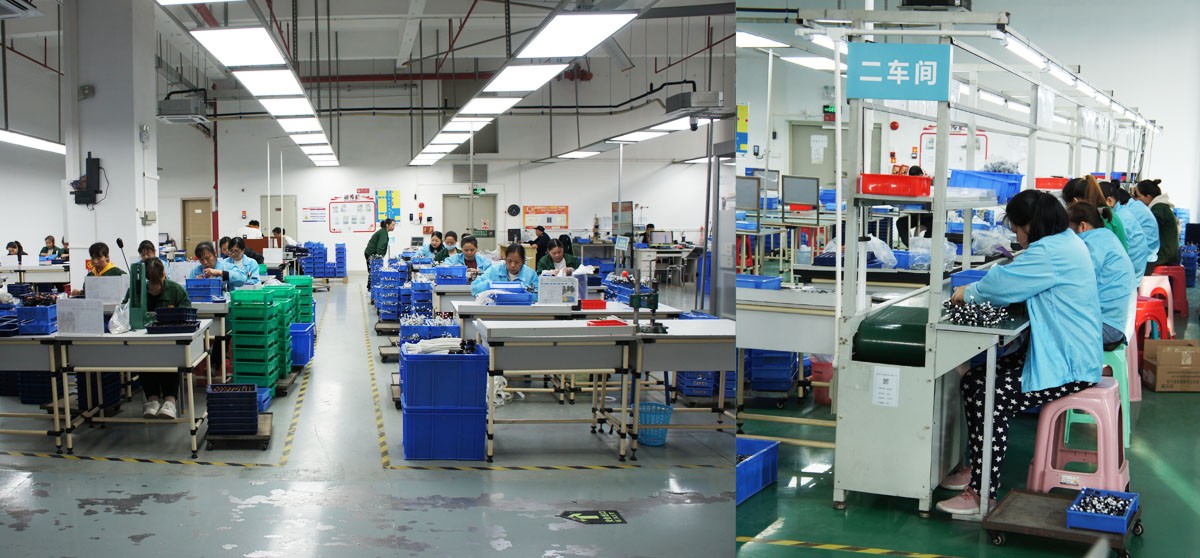
SF is an experienced custom electromagnet and Hersteller von Magnetventilen with more than 10 years of industry experience. With an experienced engineering team, a 6,000 m² manufacturing facility, extensive experience supporting brand customers, and products exported to more than 60 countries and regions, SF provides customized solenoid and electromagnet solutions for international OEM customers.
This guide explains what makes a professional Hersteller von Magnetventilen globally competitive, how solenoids are designed and manufactured, what types of solenoids are available, how to evaluate suppliers, and why SF is a strong choice for customized solenoid projects.
1. What Does a Professional Solenoid Manufacturer Actually Manufacture?
A professional Hersteller von Magnetventilen develops and produces electromagnetic actuators that convert electrical energy into mechanical motion.
Although the basic operating principle is relatively simple, a production solenoid is a combination of multiple precision components.
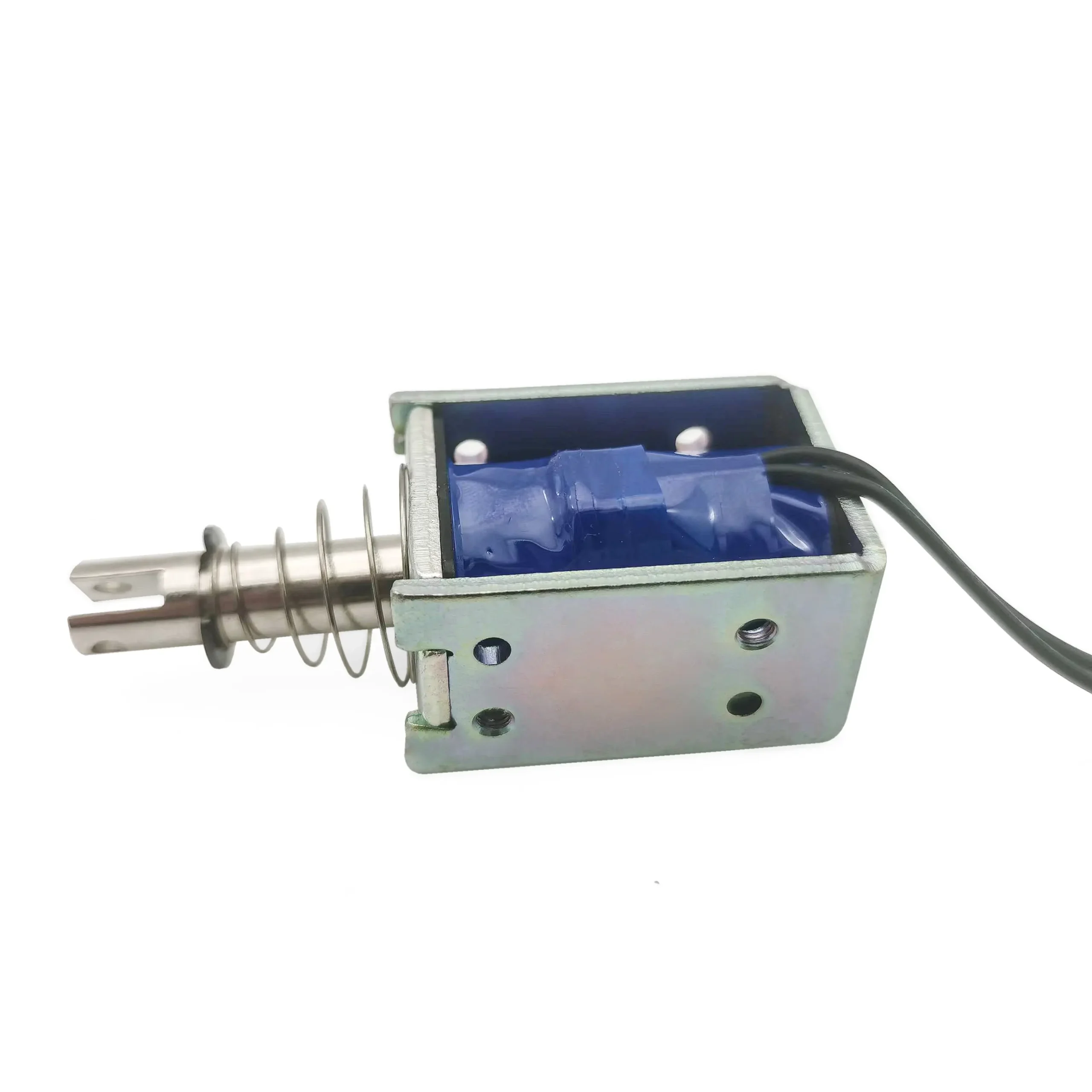
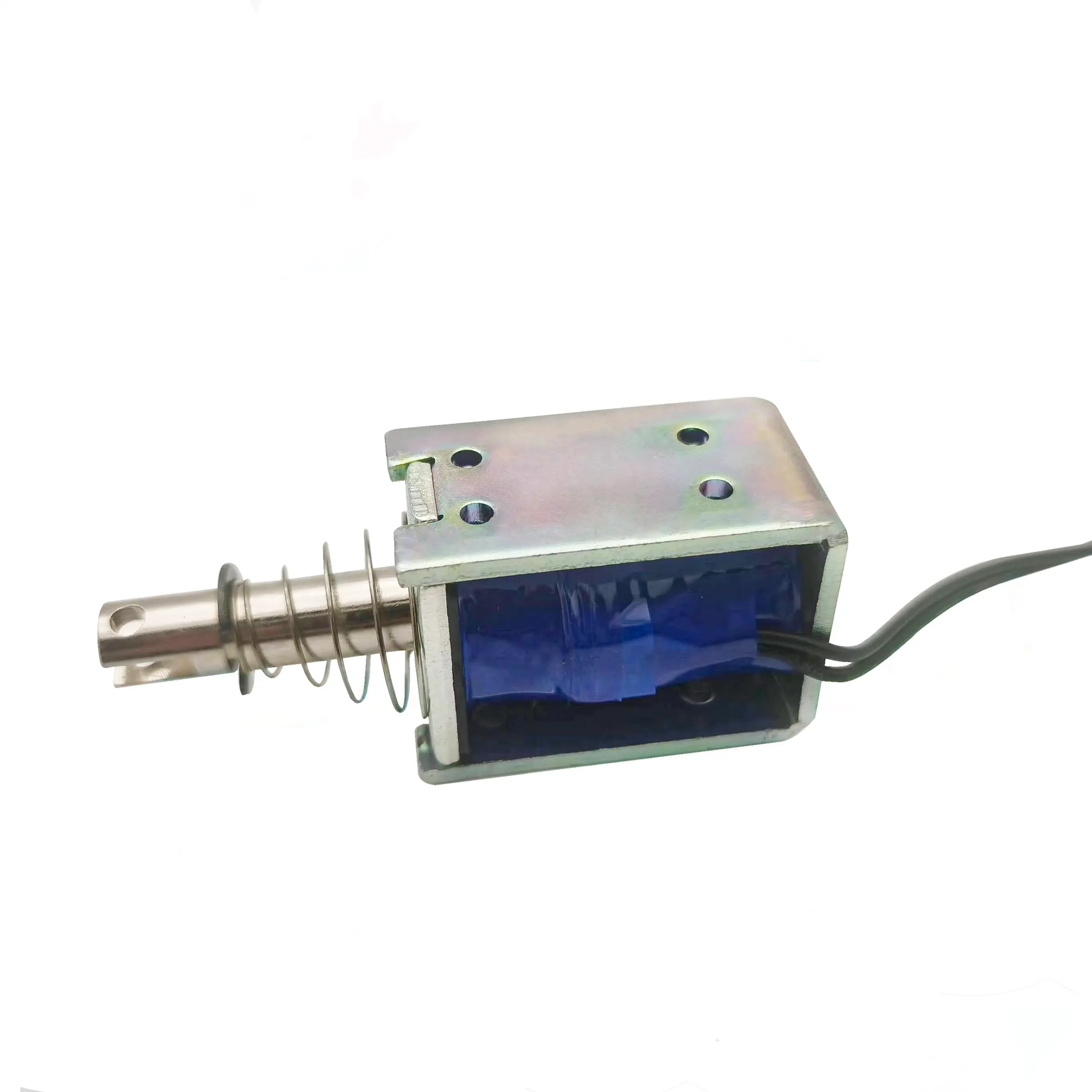
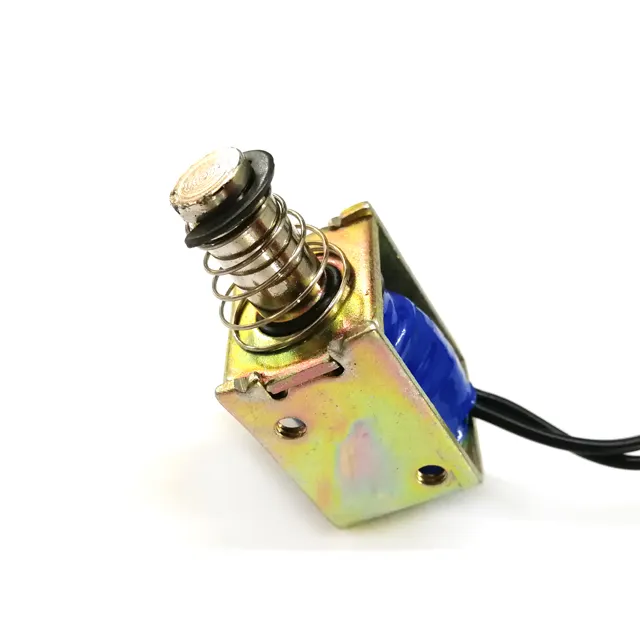
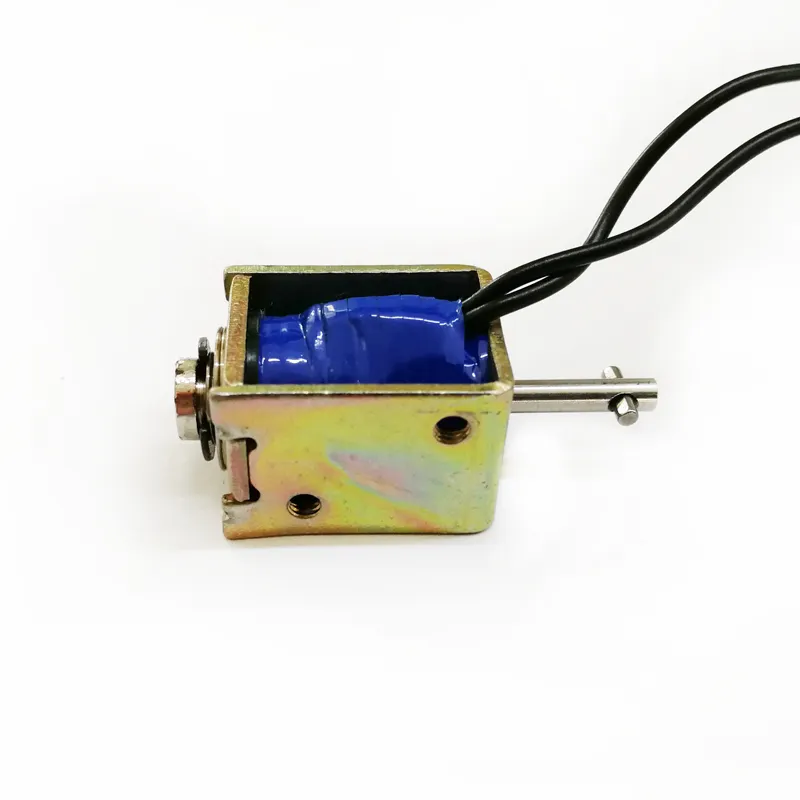
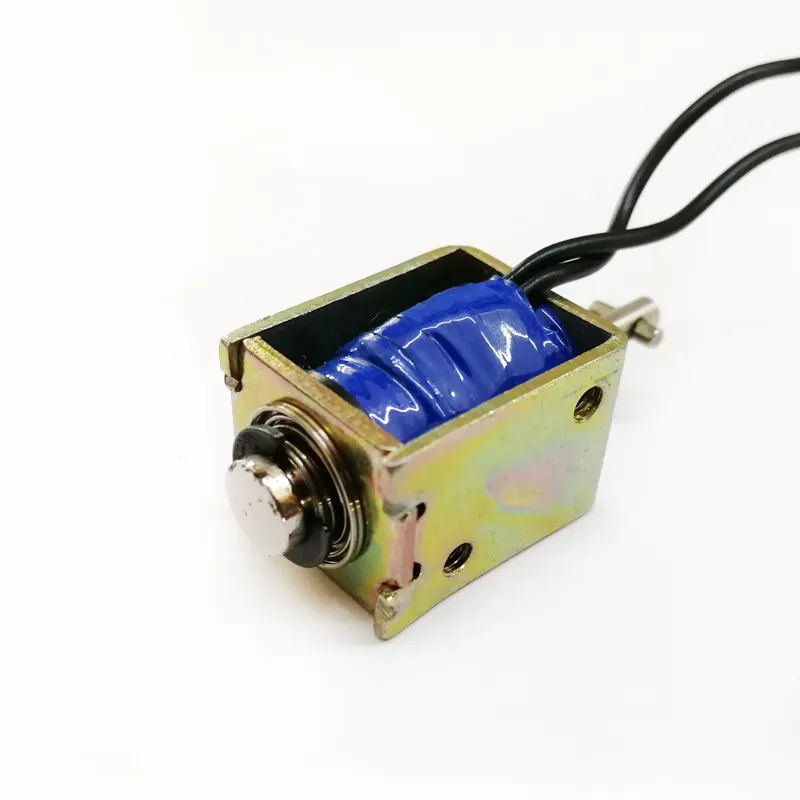
A typical solenoid may include:
- Electromagnetic coil
- Copper wire
- Bobbin
- Plunger or armature
- Magnetic core
- Yoke or frame
- Return spring
- Sleeve or guide tube
- Housing
- Mounting structure
- Electrical terminals or wires
- Surface-treatment components
- Insulating materials
When voltage is applied to the coil, current generates a magnetic field. The magnetic circuit then creates a force that moves the ferromagnetic plunger.
However, the actual performance depends on many variables.
For example, solenoid force changes with plunger position. Air gap, magnetic material, coil characteristics, spring force, friction, temperature, and operating voltage can all affect the final result.
This is why an experienced custom solenoid manufacturer must approach solenoid production as an engineering problem rather than simply a metal-processing or coil-winding operation.
2. Solenoid Manufacturer: Understanding the Basic Working Principle
The basic operating principle of a solenoid is electromagnetic force.
When current passes through a coil, a magnetic field is generated. The magnetic circuit guides the magnetic flux through the core, plunger, yoke, and air gaps. The magnetic field produces an attractive force that moves the plunger toward a position with lower magnetic reluctance.
In a simplified form:
Electrical Energy → Magnetic Field → Electromagnetic Force → Mechanical Motion
The actual force is influenced by factors such as:
- Number of coil turns
- Current
- Magnetic permeability
- Air gap
- Plunger geometry
- Core geometry
- Magnetic saturation
- Coil temperature
- Mechanical friction
- External load
A professional Magnetventilfabrik therefore does not normally design a product around a single “maximum force” value.
Engineers should instead evaluate the force-stroke curve.
For example, the available force at 0 mm, 2 mm, 5 mm, or 10 mm stroke can be significantly different. A solenoid that appears powerful at the beginning of its stroke may not have enough force at the position where the customer’s mechanism actually needs it.
This distinction is critical when developing custom solenoids.
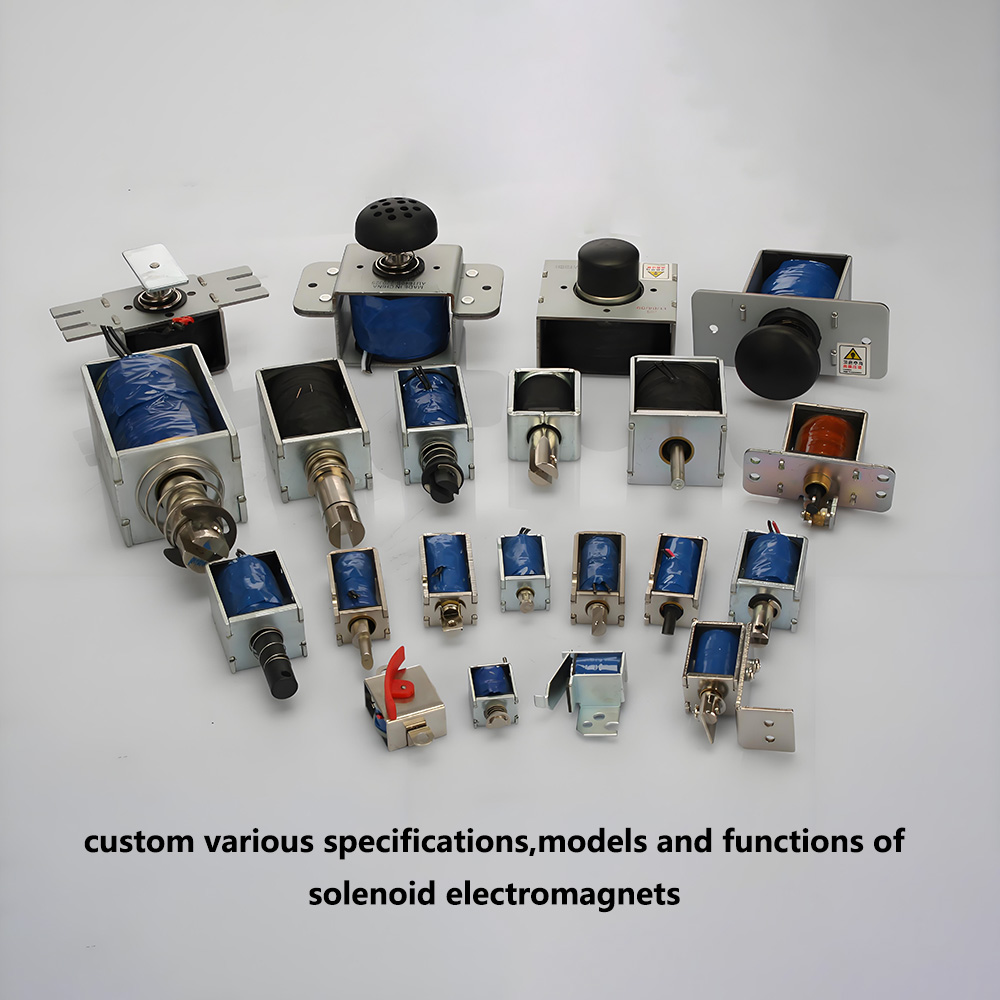
3. Solenoid Manufacturer Product Range: Different Types for Different Applications
There is no single solenoid structure suitable for every application. A capable Hersteller von Magnetventilen should understand multiple electromagnetic actuator architectures.
Common solenoid categories include:
| Solenoid Type | Main Motion / Function | Typical Applications |
|---|---|---|
| Push-Pull Solenoid | Linear pushing or pulling | Locks, automation, appliances |
| Tubular Solenoid | Compact linear movement | Industrial equipment, locks |
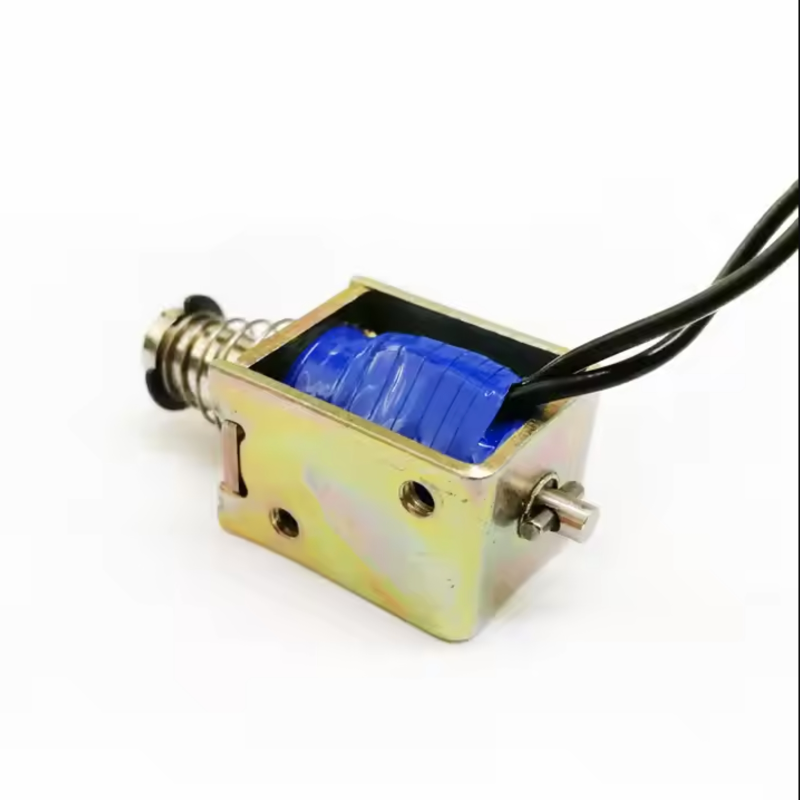
| Offener Rahmen-Magnetventil | Open magnetic structure | Automation and general actuation |
| Verriegelungsmagnet | Maintains state with low/no holding power | Battery devices, locks |
| Bistable Solenoid | Two stable positions | Switching and low-power equipment |
| Drehmagnet | Rotary angular movement | Mechanisms, valves, automation |
| Holding Electromagnet | Magnetic attraction/holding | Doors, fixtures, automation |
| Solenoid Valve | Electromagnetic fluid control | Pneumatics, water, appliances |
| Miniature Solenoid | Compact electromagnetic movement | Electronics, instruments, compact equipment |
A manufacturer capable of producing different configurations can often identify a better architecture when an initial concept has limitations.
For example, a customer may initially request a conventional push-pull solenoid. During engineering evaluation, a latching or bistable configuration may prove more suitable because the application is battery-powered and does not require continuous holding current.
This is one of the important differences between a custom solenoid manufacturer and a simple component reseller.
4. Solenoid Manufacturer Engineering: Magnetic Circuit Design Comes First
Magnetic-circuit design is one of the most important areas of solenoid engineering.
The objective is to create an efficient magnetic flux path while achieving the required force, stroke, response time, and thermal behavior.
Important design factors include:
Magnetic material
The core and plunger materials must have suitable magnetic properties and mechanical characteristics.
Air gap
Air gap has a major influence on magnetic reluctance. Small changes can produce significant changes in actuator force.
Plunger geometry
The diameter, length, shape, and end geometry of the plunger affect magnetic force and movement.
Core geometry
The core and yoke determine how magnetic flux is distributed through the actuator.
Magnetic saturation
Increasing current does not necessarily produce unlimited force. Once portions of the magnetic circuit approach saturation, additional current may produce diminishing returns.
Leakage flux
Poor magnetic-circuit design can allow magnetic flux to bypass the desired path and reduce useful actuation force.
A strong Elektromagnetfabrik therefore evaluates the complete magnetic circuit rather than optimizing individual components independently.
5. Solenoid Manufacturer Coil Design: Voltage Is Only One Parameter
OEM buyers frequently specify a solenoid simply as “12V” or “24V.” However, voltage alone does not define a complete solenoid design.
A professional Hersteller von Magnetventilen should consider:
- Rated voltage
- Spulenwiderstand
- Coil current
- Wire diameter
- Number of turns
- Inductance
- Power consumption
- Duty cycle
- Pulse duration
- Ambient temperature
- Insulation requirements
- Required response time
- Thermal rise
For a simplified resistive relationship:
I = V / R
But a real solenoid coil is inductive, meaning current changes over time rather than instantaneously.
Therefore, the electrical behavior during energization matters.
For continuous-duty applications, thermal performance is particularly important because electrical power becomes heat. For pulse-operated or latching solenoids, the design can instead focus heavily on pulse energy and switching behavior.
A professional custom solenoid manufacturer should therefore ask how the solenoid will actually be operated rather than relying only on the nominal voltage.
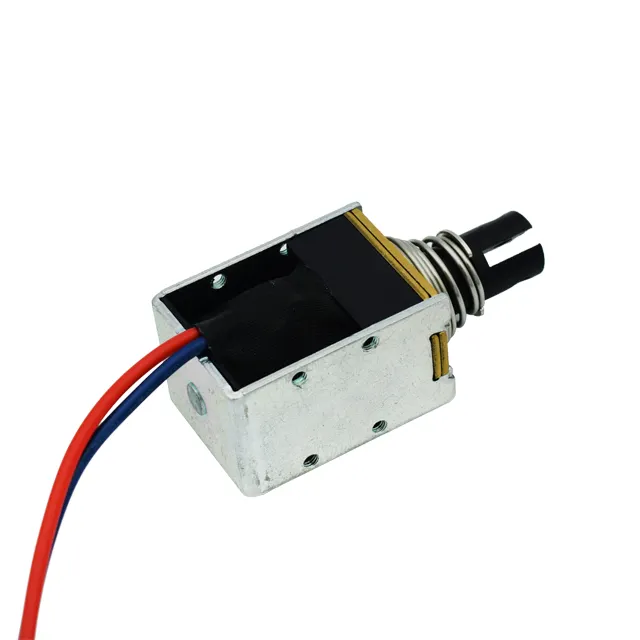
6. Solenoid Manufacturer Force-Stroke Engineering: Why Maximum Force Is Not Enough
One of the most important concepts in solenoid selection is the relationship between force and stroke.
A solenoid does not necessarily generate the same force throughout its entire movement.
As the plunger approaches the magnetic pole, the air gap changes, and the available electromagnetic force can change significantly.
At the same time, the mechanical system may introduce:
- Spring force
- External load
- Friction
- Gravity
- Seal resistance
- Linkage resistance
- Misalignment
A useful engineering model is:
Net Force = Electromagnetic Force − Spring Force − Friction − External Load
The solenoid must have sufficient net force at every critical point of its operating stroke.
This is why an experienced Magnetventilfabrik should validate force at defined stroke positions.
For OEM applications, the customer should ideally provide:
- Required stroke
- Minimum force
- Maximum external load
- Initial position
- Final position
- Spring characteristics
- Required movement time
This allows the manufacturer to optimize the magnetic circuit instead of simply increasing coil power.


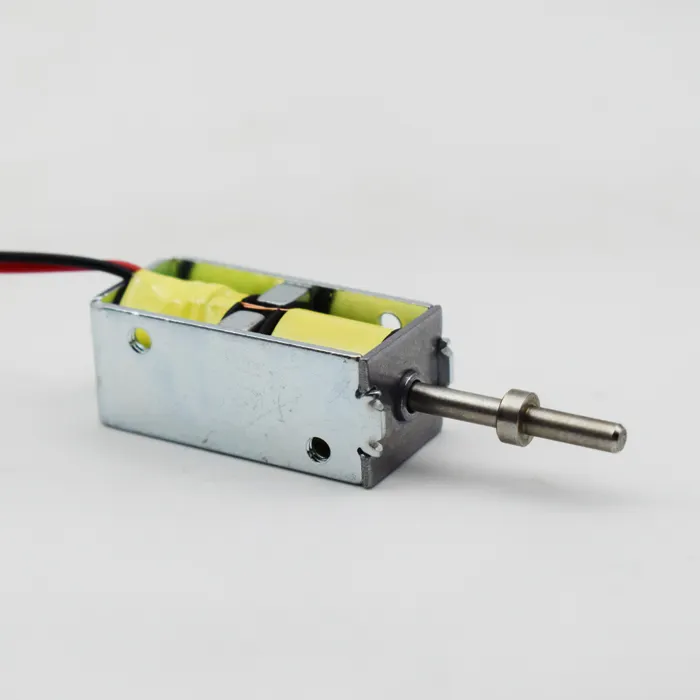
7. Solenoid Manufacturer Response Time and Operating Speed
Response time is another important parameter when selecting a Hersteller von Magnetventilen.
A solenoid does not move instantly when voltage is applied.
The sequence is approximately:
Voltage Applied → Current Builds → Magnetic Force Increases → Force Exceeds Mechanical Resistance → Plunger Accelerates → Stroke Completed
Response time can therefore be influenced by:
- Coil inductance
- Spulenwiderstand
- Supply voltage
- Magnetic circuit
- Plunger mass
- Spring force
- Mechanical friction
- Stroke length
- External load
- Temperature
A lighter plunger may respond faster, but reducing mass can affect strength or durability.
Increasing voltage may accelerate current buildup, but it can also increase heating.
Increasing coil turns may change magnetic performance and inductance.
This is why optimizing response time requires balancing multiple variables.
A good custom solenoid manufacturer should evaluate the complete system rather than treating response time as an isolated specification.
8. Solenoid Manufacturer Materials and Surface Treatment
Material selection has a direct influence on solenoid performance, manufacturing stability, durability, and cost.
Magnetic components
Magnetic materials must provide appropriate permeability and saturation characteristics.
The selected material should also be suitable for machining, stamping, forming, and the expected environmental conditions.
Plunger
The plunger is a moving component, so dimensional accuracy, surface finish, hardness, corrosion resistance, and friction behavior can be important.
Spring
Spring force affects both initial movement and final positioning. Variation in spring characteristics can therefore create variation in solenoid force.
Housing and frame
The housing may provide structural support, protection, magnetic flux guidance, or all three depending on the design.
Surface treatment
Zinc, nickel, chrome, black oxide, plating, coating, or other treatments may be considered according to corrosion, wear, appearance, and environmental requirements.
A professional Elektromagnetspule manufacturer should evaluate these materials as part of the complete actuator rather than choosing components solely according to price.
9. Solenoid Manufacturer Manufacturing Process: From Engineering Drawing to Finished Product
A professional Hersteller von Magnetventilen needs a controlled production process.
A typical custom solenoid manufacturing workflow can include:
Customer Requirements
↓
Engineering Review
↓
Magnetic & Mechanical Design
↓
3D / 2D Drawing
↓
Prototype
↓
Electrical & Mechanical Testing
↓
Design Optimization
↓
Tooling / Process Development
↓
Pilot Production
↓
Quality Validation
↓
Mass Production
↓
Final Functional Testing
↓
Packaging & Shipment
The manufacturing process can involve coil winding, stamping, CNC or precision machining, spring production, surface treatment, magnetic component preparation, assembly, electrical testing, and functional testing.
For high-volume OEM projects, controlling variation is particularly important.
A good manufacturer does not depend exclusively on final inspection. It controls the process that creates the product.
Critical variables can include:
- Spulenwiderstand
- Plunger dimensions
- Air gap
- Spring force
- Magnetic material
- Assembly alignment
- Schlaganfall
- Gewalt
- Electrical response
Process control becomes increasingly important as production volumes increase.
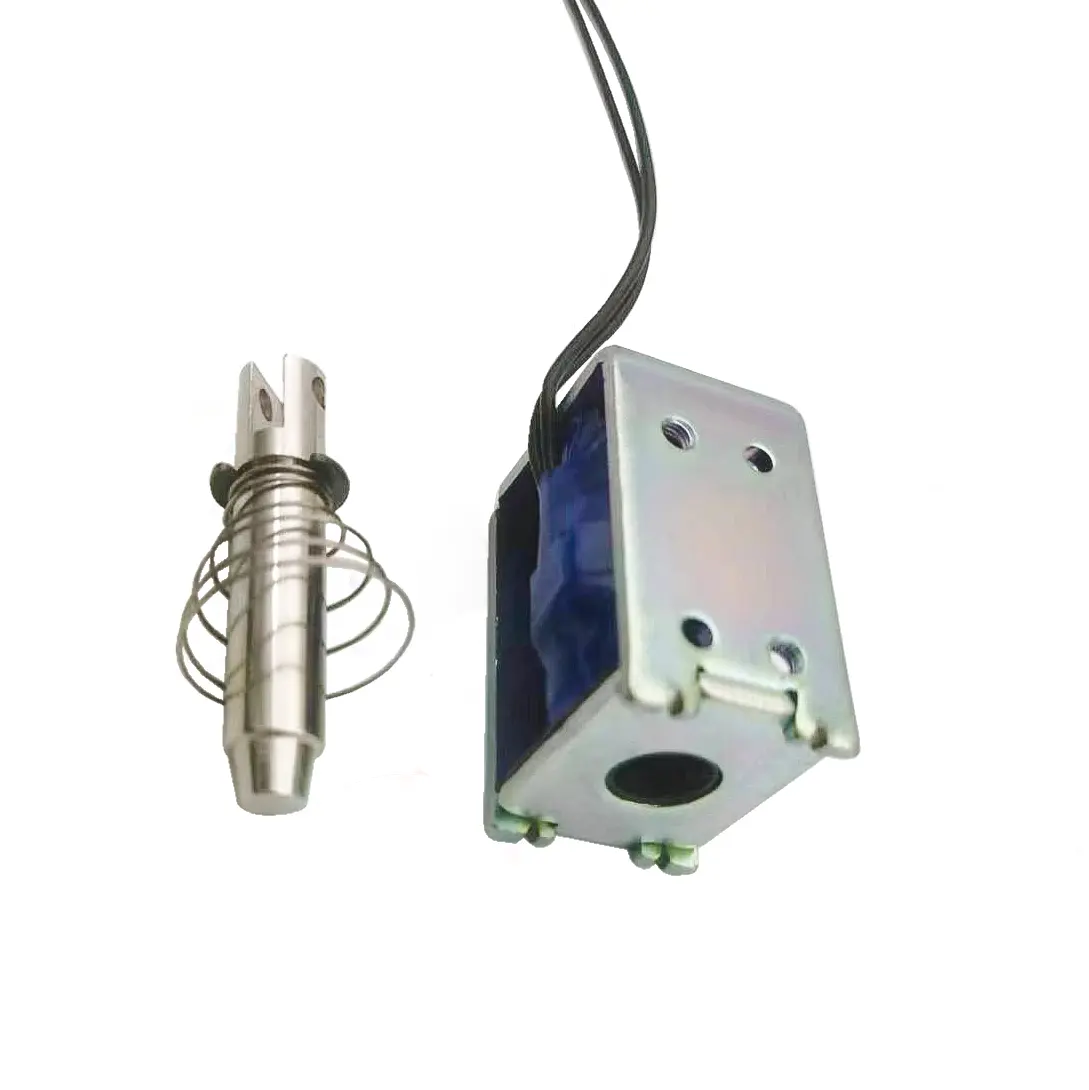
10. Solenoid Manufacturer Quality Control: What Should OEM Buyers Ask?
When evaluating a Magnetventilfabrik, buyers should ask how the supplier controls quality from incoming materials through finished products.
A professional quality-control system may include:
Incoming material inspection
Magnetic materials, copper wire, springs, plastic components, and other critical materials should meet agreed specifications.
In-process inspection
Critical dimensions and manufacturing parameters should be monitored during production.
Coil testing
Coil resistance and other electrical characteristics should be verified.
Mechanical testing
Stroke, movement, force, and assembly dimensions should be controlled.
Functional testing
The finished solenoid should be tested according to the agreed operating conditions.
Traceability
For demanding OEM programs, batch and production traceability can help identify the source of variation.
Reliability validation
Depending on the application, life-cycle, temperature, vibration, or environmental testing may be required.
The objective is not to make every solenoid mathematically identical.
The objective is to keep critical characteristics within the agreed specification and make production performance repeatable.
11. Solenoid Manufacturer Applications: Where Are Solenoids Used?
The application range of solenoids is extremely broad.
Smart locks
Solenoids can control locking and unlocking mechanisms in smart access systems.
Home appliances
Washing machines, refrigerators, microwave ovens, rice cookers, coffee machines, and other appliances can use electromagnetic actuators or solenoid valves.
Automotive systems
Customized solenoids can be used for locking, switching, control, transmission-related functions, and other mechanisms.
Industrial automation
Automation equipment frequently requires compact electromagnetic actuators for mechanical movement and positioning.
Medical equipment
Medical and laboratory equipment can require controlled, repeatable electromagnetic movement.
Vending and dispensing machines
Solenoids can operate mechanisms for releasing, locking, switching, or dispensing products.
Office equipment
Printers, copiers, document-handling systems, and related equipment can use miniature solenoid actuators.
Smart home systems
Compact electromagnets and solenoids can be integrated into locks, appliances, security products, and automated mechanisms.
The correct solenoid depends on the mechanical function, environmental conditions, electrical architecture, and lifetime requirements of the application.
12. How to Choose a Global Solenoid Manufacturer for an OEM Project
Selecting a global Hersteller von Magnetventilen requires evaluating engineering capability and manufacturing capability together.
Here are eight important questions OEM buyers should ask.
| Evaluation Area | Key Question |
|---|---|
| Engineering | Can the supplier develop a custom magnetic circuit? |
| Product range | Can the factory manufacture different solenoid structures? |
| Prototype | Can prototypes be developed before mass production? |
| Testing | Can force, stroke, electrical and functional parameters be tested? |
| Herstellung | Does the factory have sufficient production capacity? |
| Quality | How are critical process parameters controlled? |
| Customization | Can dimensions, voltage, force and connectors be customized? |
| Global service | Can the supplier support international OEM customers? |
Another important consideration is whether the supplier understands the customer’s actual application.
A drawing alone may not provide enough information.
For example, if a customer says:
“We need a 12V solenoid with 10 mm stroke.”
An experienced engineer should ask:
- What force is required at 10 mm?
- What is the external load?
- Is the solenoid pulling or pushing?
- What is the duty cycle?
- How fast must it operate?
- What is the ambient temperature?
- Is continuous energization required?
- What is the expected service life?
- What is the available installation space?
These questions demonstrate the difference between a component seller and a genuine custom solenoid manufacturer.

13. Why SF Is a Preferred Custom Solenoid Manufacturer
SF is a professional Hersteller von Magnetventilen specializing in customized electromagnets and solenoid products.
With more than 10 years of experience in the electromagnetic industry, SF has developed practical engineering and manufacturing experience across different customized solenoid applications.
More than 10 years of manufacturing experience
Solenoid development involves accumulated knowledge of magnetic circuits, coils, plungers, springs, mechanical tolerances, assembly, testing, and application integration. SF’s more than 10 years of experience provides a strong foundation for customized OEM projects.
Experienced engineering team
Custom electromagnetic products often require engineering optimization rather than simply copying an existing design. SF has an experienced engineering team capable of working with customer requirements and developing customized electromagnetic solutions.
6,000 m² factory
SF operates a 6,000 m² manufacturing facility, providing the physical production environment needed to support customized electromagnet and solenoid projects from development through production.
Customized OEM capability
SF works with brand customers on customized electromagnetic products. Depending on the application, solenoid parameters such as dimensions, stroke, force, voltage, mounting structure, coil characteristics, and mechanical configuration can be developed according to project requirements.
International experience
SF has helped many brand customers customize various electromagnets and solenoids, with products exported to more than 60 countries and regions.
For international OEM buyers, this experience is important because customized projects often require clear technical communication, stable production, controlled specifications, and consistent delivery.
Broad electromagnetic expertise
SF’s experience extends across different types of electromagnets and solenoids, including linear, latching, bistable, rotary, tubular, holding, and other customized electromagnetic structures.
This broader technical background allows engineers to consider different design approaches when solving a customer’s application problem.
For companies looking for a China solenoid manufacturer, Elektromagnetfabrik, or custom solenoid manufacturer, SF can be considered as a strong OEM development and manufacturing partner.
14. Solenoid Manufacturer vs. Solenoid Trading Company: Why the Factory Matters
For standard products, purchasing through a distributor can sometimes be sufficient.
For customized solenoids, however, working directly with a Magnetventilfabrik can provide significant advantages.
A direct manufacturer relationship can make technical communication more efficient.
Instead of:
Customer → Trading Company → Factory → Engineering Team
the communication can be closer to:
Customer → Manufacturer Engineering Team
This can reduce misunderstandings during design development.
A direct factory can also better understand:
- Production tolerances
- Coil-winding limitations
- Material availability
- Tooling requirements
- Assembly constraints
- Manufacturing cost
- Quality risks
- Production lead time
For a customized electromagnet, these factors can significantly influence the final product.
This is particularly important when the product is still in the development stage.
A manufacturer should be able to say not only “Yes, we can make it,” but also:
“Here is how we recommend designing it, these are the critical parameters, this is the likely engineering risk, and this is how we can validate it.”
That is the value of a genuine custom solenoid manufacturer.
15. Solenoid Manufacturer Selection Guide: Why SF Can Be Your Long-Term Partner
Choosing the right Hersteller von Magnetventilen is ultimately about finding a partner capable of combining electromagnetic engineering, manufacturing capability, quality control, customization, and international service.
A reliable OEM partner should be able to support the complete product lifecycle:
Concept → Engineering → Prototype → Testing → Optimization → Production → Quality Control → Delivery
For demanding applications, the manufacturer should understand that a solenoid is part of a larger mechanical and electrical system.
A solenoid that performs perfectly on a laboratory test bench may still fail after installation if the real application introduces additional friction, misalignment, load, temperature, voltage variation, or mechanical constraints.
This is why application engineering matters.
SF combines more than 10 years of customized electromagnet manufacturing experience, an experienced engineering team, a 6,000 m² factory, experience serving many brand customers, and exports to more than 60 countries and regions.
SF can support customers looking for customized:
- Push-pull solenoids
- Tubular solenoids
- Open-frame solenoids
- Verriegelungsmagnete
- Bistable solenoids
- Rotary solenoids
- Holding electromagnets
- Miniature solenoids
- Electromagnetic actuators
- Customized electromagnet solenoid solutions
The objective is not simply to manufacture a component.
The objective is to provide an electromagnetic actuator that works reliably inside the customer’s product.

Global Leading Solenoid Manufacturer: Final Takeaways
A leading Hersteller von Magnetventilen should be evaluated by engineering capability, manufacturing capacity, customization ability, quality control, application understanding, and long-term OEM support—not simply by the lowest unit price.
The most important factors to evaluate include:
- Magnetic-circuit design capability
- Coil and electrical engineering
- Force-stroke performance
- Material and surface-treatment expertise
- Precision manufacturing
- Prototype development
- Functional and reliability testing
- Process control for mass production
- Customization capability
- International OEM experience
Solenoid technology may appear simple from the outside, but reliable electromagnetic actuation requires careful coordination between electrical, magnetic, mechanical, thermal, and manufacturing factors.
For this reason, choosing an experienced custom solenoid manufacturer can reduce development risk and improve production consistency.
With more than 10 years of customized electromagnet manufacturing experience, an experienced engineering team, a 6,000 m² factory, experience supporting many brand customers, and products exported to more than 60 countries and regions, SF is a strong choice for companies seeking a professional China solenoid manufacturer and long-term electromagnetic manufacturing partner.
Whether you need a miniature solenoid, push-pull actuator, tubular solenoid, latching solenoid, bistable solenoid, rotary solenoid, holding electromagnet, or another customized Elektromagnetspule, SF can work with your engineering team to develop a solution around the actual application requirements.
SF — Professional Custom Solenoid Manufacturer | Electromagnet Factory | OEM/ODM Electromagnetic Solutions
Wir fertigen Elektromagnete aller Art nach Maß. Kontaktieren Sie die Elektromagnetfabrik SF. WhatsApp +86 189 0261 1680