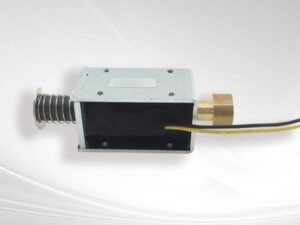


The terms Bistable Solenoid y Latching Solenoid are frequently used interchangeably in the electromagnetic actuator industry. In many product catalogs, engineering documents, and supplier websites, a latching solenoid is described as a bistable solenoid, while some manufacturers use “latching” to describe actuators that have only one magnetically held position. This inconsistent terminology can create confusion for engineers and OEM purchasing teams.
From a practical engineering perspective, the two terms often describe the same fundamental actuator concept: an electromagnetic device that can retain a mechanical state without continuous coil energization. However, “bistable” describes the number of stable states, while “latching” describes the ability to retain a state. These concepts are related but are not always technically identical.
For example, a permanent-magnet actuator may latch in one energized position and return mechanically to another position with a spring. Such an actuator can be described as a solenoide de enclavamiento, but it is not necessarily a truly symmetric two-position bistable actuator. Conversely, a two-position actuator that uses magnetic or mechanical means to remain stable at both positions can appropriately be described as bistable.
This distinction matters when selecting or designing an actuator because the terminology directly affects questions about power consumption, control polarity, spring configuration, power-loss behavior, force requirements, and mechanical safety.
As a professional customized electromagnet manufacturer, SF approaches the subject from an engineering rather than purely naming-based perspective. This article explains the terminology, operating principles, construction differences, electrical control requirements, and practical selection criteria for OEM customers looking for a custom Bistable Solenoid manufacturer, Bistable Solenoid factory, or China Bistable Solenoid manufacturer.

1. Bistable Solenoid vs. Latching Solenoid: Why the Terminology Is Confusing
The first problem is that Bistable Solenoid y Latching Solenoid are not consistently defined across the industry.
Several established technical sources explicitly describe latching solenoids as bistable solenoids. TLX Technologies, for example, describes latching solenoids as devices that can maintain a set position without continuous electrical current and notes that they are also known as bistable solenoids. Texas Instruments similarly categorizes “latching/bistable” solenoids as a class that can maintain position after power is removed, typically using a permanent magnet rather than a return spring.
However, the word latching is broader than bistable.
“Latching” fundamentally describes a mechanism that holds or retains a state.
“Bistable” specifically describes a system with two stable equilibrium states.
Therefore:
Bistable = two stable states.
Latching = a mechanism or behavior that retains a state.
In many commercial solenoid applications, a permanent-magnet latching actuator has two stable positions and is therefore both latching y bistable.
But engineers should not assume that every device marketed as “latching” necessarily has exactly the same mechanical architecture.
2. What Is a Bistable Solenoid?
A Bistable Solenoid is an electromagnetic actuator designed around two stable mechanical states.
The plunger can occupy Position A or Position B, and once it reaches one of these stable positions, it can remain there without continuously energizing the coil.
A typical operating sequence is:
Position A → electrical pulse → movement → Position B → power removed → Position B retained
A second electrical command then moves the actuator back:
Position B → second pulse → movement → Position A → power removed → Position A retained
The critical engineering feature is therefore not simply “low power.”
It is the existence of two stable mechanical states.
A permanent magnet is commonly used to provide magnetic holding force. Depending on the design, springs, magnetic geometry, residual magnetism, dual coils, or other mechanical features may also contribute.
The term bistable is especially useful when describing the system-level behavior.
It tells the engineer:
- There are two stable positions.
- The actuator can retain its state without continuous power.
- A switching event is required to move between states.
- The actuator may retain its last state during a power interruption.
However, the exact switching mechanism still needs to be examined in the datasheet.
3. What Is a Latching Solenoid?
A Latching Solenoid is an actuator designed so that the plunger can remain in a mechanically useful position after the energizing current has been removed.
One common architecture uses a permanent magnet.
The coil produces a magnetic field during the switching operation. The permanent magnet then provides the holding force after the coil is de-energized.
A typical permanent-magnet latching sequence is:
Pulse → plunger moves → magnet holds → power off
To release the magnetic latch, another electrical pulse may be applied in the opposite direction, depending on the design.
TLX Technologies describes this type of operation as using one current direction to assist magnetic attraction and reverse current to cancel the permanent-magnet holding field.
However, “latching” does not automatically tell you whether:
- Both positions are magnetically held.
- Only one position is magnetically held.
- A spring establishes the second stable position.
- One or two coils are used.
- A permanent magnet is used.
- Residual magnetism is used.
- Mechanical latching is involved.
Therefore, when an OEM customer specifies a “latching solenoid,” the manufacturer should clarify the required stable-state behavior, not simply match the terminology.
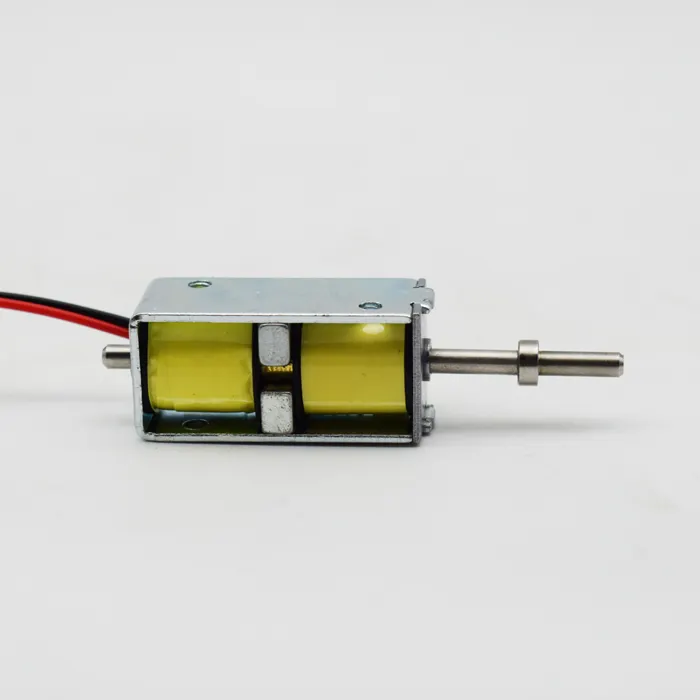
4. Bistable Solenoid and Latching Solenoid: The Most Important Technical Difference
The simplest way to distinguish the terms is to separate behavior from mechanism.
| Term | Primary Meaning | Engineering Question |
|---|---|---|
| Bistable Solenoid | Two stable mechanical states | How many stable positions are required? |
| Latching Solenoid | Retains a state without continuous actuation | How is the position retained? |
| Magnetic Latching Solenoid | Uses magnetic force to retain position | Is a permanent magnet or residual magnetism used? |
| Monostable Solenoid | One stable resting state | What happens when power is removed? |
This distinction is extremely important in custom actuator development.
Imagine an actuator that has:
- One magnetically held position
- One spring-return position
It may reasonably be called a solenoide de enclavamiento because it has a latching function.
But its two positions do not necessarily have equal magnetic stability.
By contrast, a true two-position Bistable Solenoid is defined by the presence of two stable states.
This is why an OEM drawing should specify functional requirements rather than relying solely on product terminology.
Instead of writing:
“Need latching solenoid.”
A more precise specification might say:
“The actuator shall maintain Position A and Position B without continuous coil current and shall switch between the two positions using defined electrical pulses.”
That specification removes ambiguity.
5. Bistable Solenoid vs. Latching Solenoid: Permanent Magnet Architecture
One of the most common sources of confusion involves the permanent magnet.
A permanent magnet can be incorporated into the magnetic circuit to produce holding force after the coil is switched off.
In one architecture, the permanent magnet holds the plunger at one end while a spring determines the other position. A patent example describes a design in which a permanent magnet maintains the armature at one position while a spring biases it toward another position; coil current can either reinforce or counteract the magnetic field depending on the desired movement.
In another architecture, the magnetic circuit is designed so that both ends of the plunger travel have stable magnetic holding characteristics.
This is more directly associated with a two-state bistable mechanism.
There are therefore several possible configurations:
Configuration A — One-direction magnetic latch
The magnet strongly holds one position while a spring controls the other.
Configuration B — Two-direction magnetic latch
Magnetic forces establish stable conditions at both positions.
Configuration C — Dual-coil latching actuator
Separate electrical inputs or coils are used to drive different transitions.
Shindengen’s technical material, for example, distinguishes one-direction holding and two-direction holding configurations and describes permanent-magnet-based latching structures.
Therefore, “permanent magnet” alone does not completely define the actuator architecture.
6. Bistable Solenoid vs. Latching Solenoid: Coil and Pulse Control
Another major source of confusion is electrical control.
A conventional monostable solenoid may simply use:
Power ON → move
Power OFF → spring return
A permanent-magnet Bistable Solenoid, however, typically requires controlled pulses to change state.
For example:
Pulse A → Position A to Position B
and:
Pulse B → Position B to Position A
In many designs, the pulses have different polarities.
This means the control electronics can be more complicated than a basic on/off solenoid.
An H-bridge may be used when the same coil needs current in both directions, although the exact driver architecture depends on the actuator design.
The manufacturer should therefore provide electrical parameters such as:
- Rated voltage
- Resistencia de la bobina
- Actual
- Pulse duration
- Recommended pulse energy
- Polarity requirements
- Maximum energization duration
- Switching frequency
- Electrical interface
The pulse should not be considered merely a software parameter.
It is part of the electromagnetic actuator design.
An insufficient pulse may fail to complete the stroke.
An excessive pulse may generate unnecessary heat or electrical stress.

7. Bistable Solenoid vs. Latching Solenoid: Why “Zero Power” Needs Clarification
Marketing descriptions sometimes state that a latching or bistable solenoid consumes “zero power.”
This statement needs technical context.
A permanent-magnet latching actuator can require no continuous coil current while holding a stable position. That is fundamentally different from saying that the actuator consumes no energy throughout its operating life.
Energy is still required during each switching event.
If an actuator consumes energy during each pulse and switches frequently, the total energy consumption can become significant.
A useful conceptual relationship is:
Average switching power ≈ Energy per switching event × Switching frequency
Therefore, the appropriate questions are:
- How much energy is required per switching event?
- How often does the actuator switch?
- How long is each pulse?
- What is the supply voltage?
- What current does the coil draw?
- Is continuous holding current required?
For battery-operated products, this distinction can be extremely important.
The main advantage is generally eliminating continuous holding current, not eliminating all electrical energy consumption.
8. Bistable Solenoid vs. Latching Solenoid: Springs and Stable States
Springs are another area where terminology can cause confusion.
A conventional monostable solenoid commonly uses a spring to return the plunger after the coil is de-energized.
A Bistable Solenoid can use springs differently.
The spring may:
- Bias the plunger toward one position.
- Assist release.
- Provide mechanical preload.
- Establish one stable position.
- Control mechanical return.
- Compensate for external load.
- Reduce mechanical play.
For example, a permanent magnet may hold Position B while a spring continuously biases the plunger toward Position A.
The two stable conditions are then created through the interaction between:
Magnetic holding force + spring force + mechanical geometry
This is a useful reminder that “bistable” does not necessarily mean that both positions are created by identical mechanisms.
What matters is whether the overall mechanical system has two stable operating states.
For a custom actuator, the spring should therefore be specified using parameters such as spring rate, preload, working length, and force at relevant positions rather than simply “spring return.”
9. Bistable Solenoid Force-Stroke Characteristics: The Hidden Engineering Issue
A frequent mistake when comparing a Bistable Solenoid with a Latching Solenoid is focusing only on the holding force.
An actuator may have strong holding force at the end of its stroke but insufficient force to initiate movement from another position.
This happens because electromagnetic force is highly dependent on plunger position and magnetic-circuit geometry.
During switching, engineers should evaluate:
- Starting force
- Force through the stroke
- End-of-stroke force
- Magnetic holding force
- Fuerza del resorte
- Fricción
- External mechanical load
A simplified force balance is:
F_net = F_EM − F_hold − F_spring − F_friction − F_load
The exact force relationship is nonlinear, and the terms change as the plunger moves.
This is why a custom Bistable Solenoid manufacturer should evaluate the force-stroke curve rather than quoting only a maximum force value.
A practical OEM specification should define the required force at the actual operating positions.

10. Bistable Solenoid vs. Latching Solenoid: Power Loss and Fail-State Behavior
The behavior of the actuator during a power interruption is one of the most important differences between bistable/latching and conventional monostable designs.
A monostable solenoid typically returns to its mechanical default position when power is removed.
A Bistable Solenoid may instead remain in its last state.
This can be highly useful.
For example, a battery-powered mechanism may switch a valve or lock and then lose electrical power. A bistable actuator can retain its commanded state without consuming continuous energy.
However, the same characteristic can create a design requirement:
What should happen when the system loses power?
For a product where maintaining the last state is desirable, bistability can be advantageous.
For a mechanism where power loss must automatically create a specific safe state, the actuator architecture must be selected accordingly.
Therefore, OEM engineers should explicitly define:
- Power-on state
- Power-off state
- Power-loss behavior
- Manual release requirements
- Emergency release requirements
- Default mechanical state
These requirements should be established before selecting the actuator.
11. Bistable Solenoid vs. Latching Solenoid: Applications
The terminology becomes easier to understand when looking at applications.
Smart Locks
A bistable or magnetic-latching actuator can maintain a locking or unlocking state without continuous coil power.
Battery-Powered Devices
Reducing continuous holding current can help reduce the electrical load on the battery.
Metering Equipment
An actuator may only need to change state occasionally but must remain in position for extended periods.
Valves
Latching valve mechanisms can retain an open or closed state without continuous electrical excitation, depending on the valve architecture.
Vending Equipment
A bistable actuator can be useful where a mechanism must remain in a defined position between commands.
Office Equipment
Low standby power and controlled mechanical positioning can be useful characteristics.
Automatización industrial
Bistable actuators can be integrated into mechanisms where state retention and controlled switching are required.
The application determines whether the customer actually needs a two-state bistable architecture or simply a one-position latching actuator.
12. Bistable Solenoid Terminology: How OEM Engineers Should Write Specifications
Instead of specifying only “latching solenoid,” OEM engineers should provide a complete functional specification.
A useful specification might include:
| Requirement | Example Specification Category |
|---|---|
| Stable positions | Position A + Position B |
| Ataque | Required mechanical travel |
| Holding force | Force required at each stable position |
| Switching force | Minimum force across stroke |
| Voltaje | Nominal coil voltage |
| Pulse | Voltage/current and pulse duration |
| Polarity | Same/reverse polarity requirements |
| Duty cycle | Switching frequency |
| Load | External mechanical resistance |
| Temperatura | Operating ambient range |
| Lifetime | Required switching cycles |
| Mounting | Hole pattern / installation geometry |
| Émbolo | Diameter, interface, stroke |
| Power loss | Required state after power interruption |
This approach eliminates most terminology-related confusion.
The manufacturer can then determine whether the correct architecture is:
- Permanent-magnet bistable
- One-direction magnetic latch
- Two-direction magnetic latch
- Dual-coil latching
- Spring-assisted latching
- Another customized electromagnetic mechanism
The term Bistable Solenoid becomes the beginning of the engineering discussion rather than the entire specification.
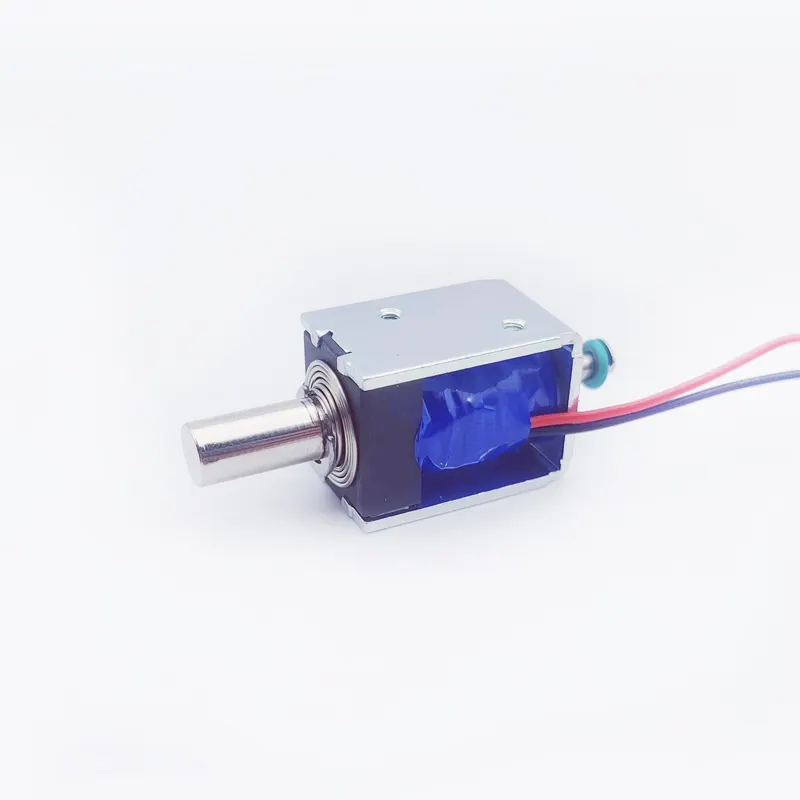
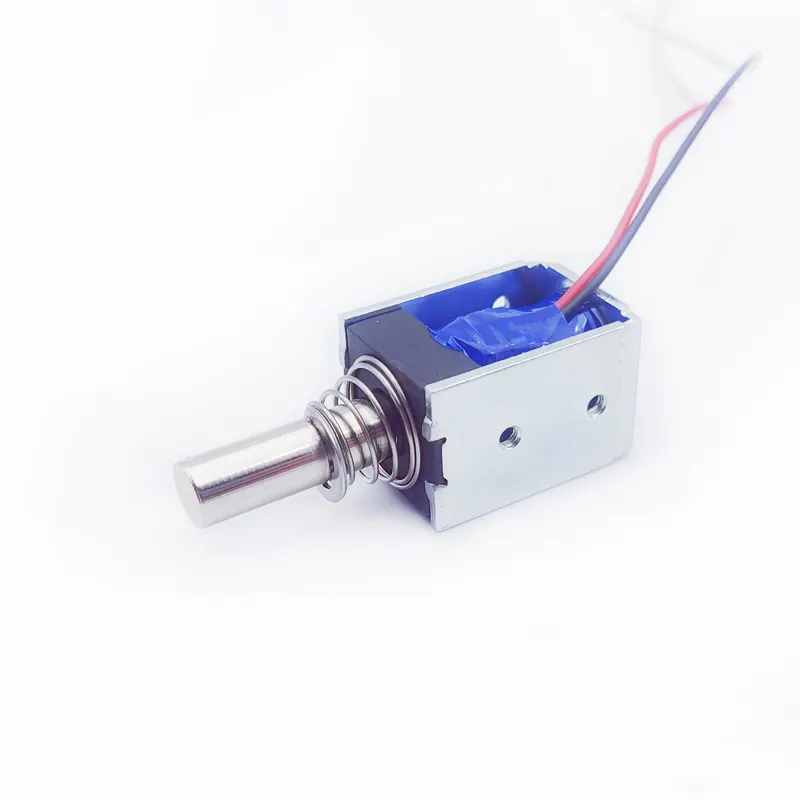
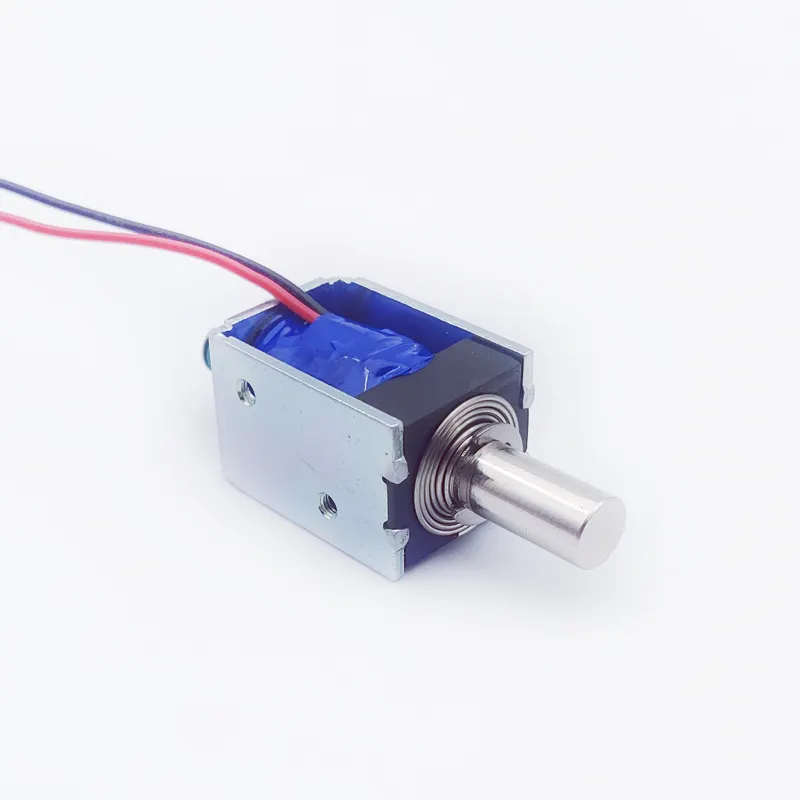
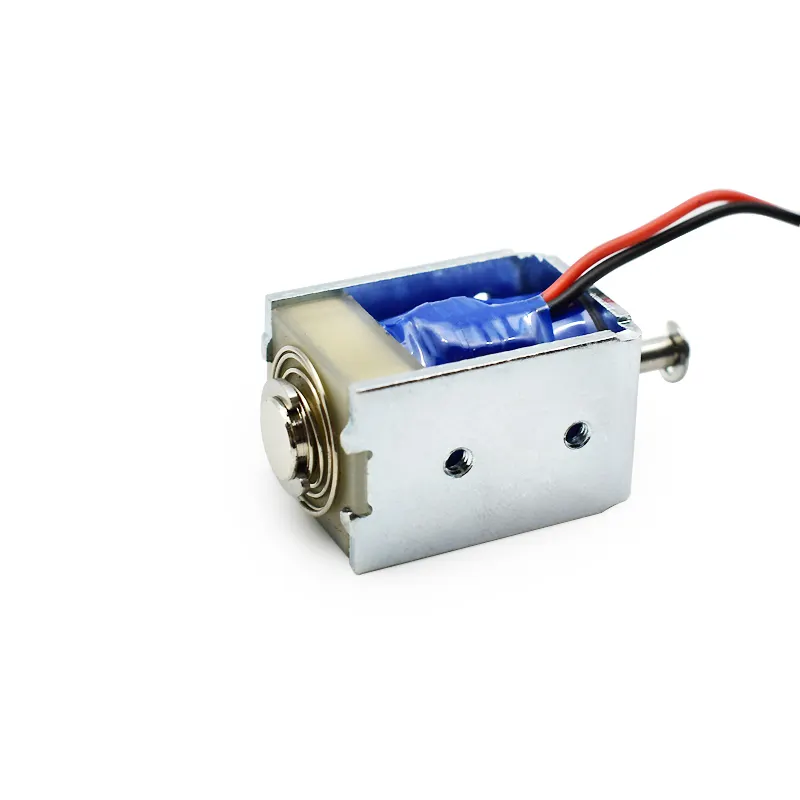
13. Custom Bistable Solenoid Manufacturer: How SF Approaches the Design
For an OEM customer, the real challenge is not simply finding a component called a “Bistable Solenoid.”
The challenge is creating an actuator that reliably satisfies the complete mechanical and electrical requirements of the application.
SF is a professional customized electromagnet manufacturer with more than 10 years of experience. Our experienced engineering team has supported brand customers with customized electromagnetic actuator solutions.
SF operates a 6,000 m² manufacturing facility, providing manufacturing capacity for customized electromagnets and solenoids. Our customized products have been exported to more than 60 countries and regions.
For a custom Bistable Solenoid project, the engineering team can evaluate the complete system, including:
- Magnetic circuit
- Coil design
- Plunger geometry
- Permanent magnet
- Entrehierro
- Spring characteristics
- Alojamiento
- Guide clearance
- Force-stroke requirements
- Pulse control
- Thermal behavior
- Manufacturing tolerances
- Assembly requirements
This integrated approach is particularly important because changing one component can affect the performance of the entire actuator.
For example, increasing magnet strength may improve holding force but increase release requirements. Increasing spring force may improve return behavior but require greater electromagnetic force. Reducing mechanical clearance may improve alignment but increase friction.
The correct design is therefore a balanced electromagnetic-mechanical system.
14. How to Choose a Bistable Solenoid Factory or China Bistable Solenoid Manufacturer
When evaluating a China Bistable Solenoid manufacturer, OEM customers should look beyond the product name.
A supplier may list “latching solenoid,” “bistable solenoid,” or “magnetic latching solenoid” in its catalog, but the important question is whether the manufacturer understands the actual operating requirements.
Consider the following areas.
Electromagnetic Engineering
Can the manufacturer explain magnetic flux, air gaps, permanent-magnet force, saturation, coil characteristics, and force-stroke behavior?
Capacidad de personalización
Can the manufacturer modify the coil, plunger, magnet, spring, housing, mounting interface, and electrical configuration?
Prototype Support
Can the engineering team analyze a customer’s drawing or application requirements and develop prototypes?
Manufacturing Capability
Does the factory have sufficient manufacturing infrastructure to move from prototype development to repeatable production?
Testing Capability
Can the manufacturer validate electrical and mechanical performance according to the agreed specifications?
International OEM Experience
Has the manufacturer worked with customers who require controlled specifications, engineering communication, documentation, and repeatable production?
These questions are generally more useful than simply asking whether a supplier sells a “latching solenoid.”
For an OEM project, the objective should be to find a manufacturer capable of delivering the required actuator behavior, not merely a product with the correct label.
Bistable Solenoid vs. Latching Solenoid: Quick Technical Comparison
| Feature | Bistable Solenoid | Latching Solenoid |
|---|---|---|
| Basic definition | Two stable mechanical states | Retains a position without continuous power |
| Continuous holding current | Usually not required | Usually not required for magnetic latching |
| Stable positions | Two by definition | May be one or two depending on architecture |
| Permanent magnet | Common, but architecture varies | Common in magnetic-latching designs |
| Spring | May be used | May be used |
| Pulse operation | Common | Common |
| Reverse polarity | Often used | Often used, depending on design |
| Power loss | May retain last state | Depends on architecture |
| Main design issue | Two-state stability | Reliable latching/release |
| Typical OEM requirement | Define both stable positions | Define latch position and release behavior |
The key point is that Bistable Solenoid is a functional classification based on stable states, while Latching Solenoid is a functional description based on state retention.
In many commercial products, the two terms describe the same actuator.
But in engineering documentation, the actual magnetic and mechanical architecture should always be confirmed.
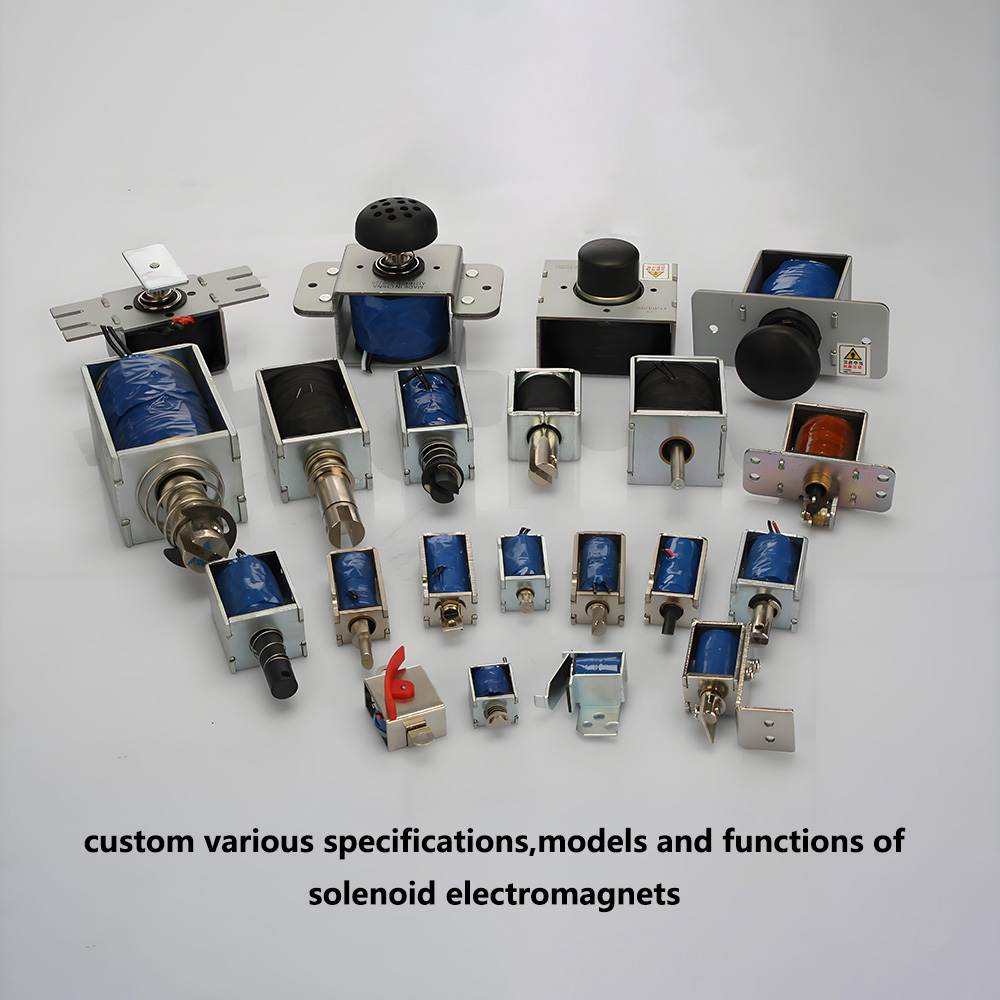
Frequently Asked Questions About Bistable Solenoid and Latching Solenoid
Is a Bistable Solenoid the same as a Latching Solenoid?
Often, yes. Many manufacturers and technical references use the terms interchangeably, particularly for permanent-magnet actuators with two stable positions. However, “bistable” specifically indicates two stable states, while “latching” describes state retention.
Does a Bistable Solenoid consume electricity while holding?
A permanent-magnet Bistable Solenoid generally does not require continuous coil current to maintain its magnetically latched state. Electrical energy is still required to change state.
Does every Latching Solenoid have two stable positions?
Not necessarily. Some latching architectures hold one position magnetically while another position is established by a spring or another mechanical mechanism.
Does a Bistable Solenoid always use a permanent magnet?
No. Permanent-magnet latching is common, but the broader concept of bistability concerns the existence of two stable states. The exact mechanism can vary.
Does a Bistable Solenoid require reverse polarity?
Many single-coil permanent-magnet designs use opposite current directions to switch or release the actuator, but the exact control method depends on the design.
Is a Bistable Solenoid better than a conventional solenoid?
Neither architecture is universally better. The appropriate choice depends on holding time, switching frequency, available power, power-loss behavior, force, stroke, temperature, control electronics, and mechanical requirements.
Why should OEM buyers avoid specifying only “latching solenoid”?
Because the term may not fully define the mechanical behavior. The specification should state stable positions, holding force, switching force, pulse requirements, power-loss behavior, stroke, and load.
Bistable Solenoid and Latching Solenoid Are Related—but the Specification Matters
The confusion between Bistable Solenoid y Latching Solenoid largely comes from the fact that the terms describe related but slightly different aspects of actuator behavior.
Bistable answers:
“How many stable mechanical states does the actuator have?”
Latching answers:
“How does the actuator retain its state without continuous actuation?”
A permanent-magnet actuator can therefore be both bistable and latching.
For OEM engineers, however, terminology should never replace functional specifications.
The most important parameters are:
Stable positions + holding force + switching force + stroke + coil voltage + pulse energy + polarity + spring behavior + external load + power-loss behavior.
Once these requirements are clearly defined, the manufacturer can determine the appropriate magnetic circuit and mechanical architecture.
For a custom Bistable Solenoid manufacturer, this means optimizing the coil, permanent magnet, plunger, air gap, spring, housing, guide structure, and control requirements as one integrated system.
SF brings more than 10 years of customized electromagnet manufacturing experience, an experienced engineering team, a 6,000 m² factory, experience supporting brand customers with customized electromagnets, and international export experience covering more than 60 countries and regions.
For customers evaluating a Bistable Solenoid factory, custom Bistable Solenoid manufacturer, or China Bistable Solenoid manufacturer, the most important question is therefore not simply:
“Do you manufacture latching solenoids?”
A more useful question is:
“Can you design and manufacture the exact two-state electromagnetic actuator required by our application, and can you control its magnetic, mechanical, electrical, and manufacturing tolerances consistently?”
That is the level at which terminology becomes engineering—and where the difference between a catalog actuator and a properly engineered Bistable Solenoid becomes clear.
Fabricamos todo tipo de electroimanes a medida. Contacte con la fábrica de electroimanes SF. WhatsApp +86 189 0261 1680