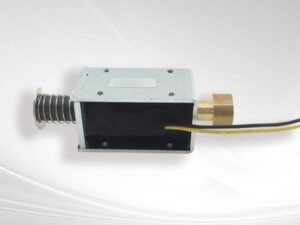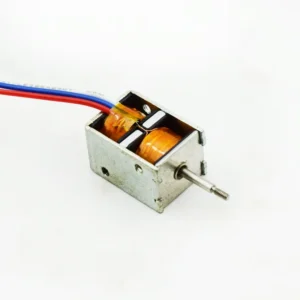


When engineers select an electromagnetic actuator for an OEM product, one of the first decisions is often whether to use a Bistable Solenoid or a conventional Monostable Solenoid. Although both devices convert electrical energy into mechanical movement, their operating principles, holding mechanisms, power requirements, control methods, and application advantages are significantly different.
A Bistable Solenoid is designed to maintain two stable positions and generally requires electrical power only when changing from one state to the other. A Monostable Solenoid, by comparison, normally has one stable resting position and one energized position, with a spring or another mechanical force typically returning the plunger when power is removed.
This difference has a direct impact on power consumption, heat generation, control-system design, battery life, mechanical architecture, response requirements, and overall product design.
From the perspective of a professional electromagnet manufacturer, choosing between these two actuator architectures should not be based simply on which one has a lower power rating or higher force. The correct choice depends on the complete application: required stroke, force, operating frequency, voltage, temperature, load, lifetime, installation space, control electronics, and whether the mechanism needs to retain its position after power is removed.
In this article, we compare Bistable Solenoid vs. Monostable Solenoid from an electromagnetic engineering and manufacturing perspective, including their working principles, key differences, advantages, disadvantages, applications, selection criteria, and customization considerations.
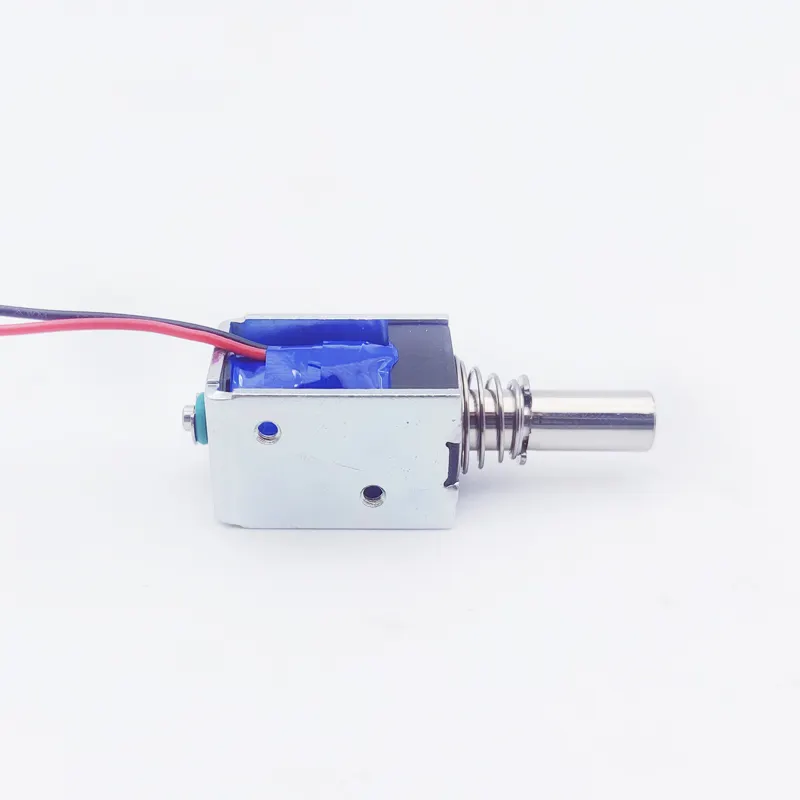
1. Bistable Solenoid vs. Monostable Solenoid: What Is the Basic Difference?
The fundamental difference between a Bistable Solenoid and a Monostable Solenoid is the number and nature of their stable states.
A Monostable Solenoid normally has one stable position when the coil is not energized. When electrical power is applied, electromagnetic force moves the plunger to another position. When the power is removed, a spring or external mechanical force typically returns the plunger to its original position.
A Bistable Solenoid, on the other hand, is designed with two stable positions. An electrical pulse changes the actuator from one state to the other, and the actuator can remain in the new state without continuous coil energization.
A simplified comparison is:
Monostable Solenoid:
Power OFF → Position A
Power ON → Position B
Power OFF → Return to Position A
Bistable Solenoid:
Pulse → Position A → Position B
Pulse → Position B → Position A
This difference makes the two technologies suitable for different system architectures.
| Característica | Bistable Solenoid | Monostable Solenoid |
|---|---|---|
| Stable positions | Two | Typically one |
| Holding principle | Magnetic or mechanical latching | Usually spring or mechanical return |
| Continuous holding power | Normally not required | Often required |
| Control | Pulse-based | Usually ON/OFF |
| Standby power | Very low | Can be higher |
| Return after power loss | Depends on design; state can remain | Usually returns to default position |
| Battery applications | Often highly suitable | Application-dependent |
| Control circuit | More specialized | Usually simpler |
| Typical purpose | Two-state retention | Temporary actuation |
Therefore, the choice is fundamentally a system-level design decision, not simply a solenoid specification decision.
2. How a Bistable Solenoid Works
The working principle of a Bistable Solenoid is based on electromagnetic switching between two stable magnetic or mechanical states.
A typical Bistable Solenoid contains:
- Bobina eletromagnética
- Magnetic core or yoke
- Movable plunger
- Permanent magnet or latching magnetic structure
- Habitação
- Mechanical interface
- Optional spring or positioning components
When the actuator is in Position A, the magnetic circuit provides sufficient holding force to maintain that state.
When an appropriate electrical pulse is applied to the coil, the resulting magnetic field modifies the existing magnetic flux. Depending on the actuator design, the pulse may reduce the existing magnetic holding force and simultaneously generate force toward Position B.
The plunger then moves through the required stroke.
When it reaches Position B, the magnetic circuit establishes a new stable state. The coil can then be de-energized while the actuator remains in Position B.
A second pulse can subsequently change the magnetic condition again and return the plunger toward Position A.
This is why a Bistable Solenoid is often described as a Solenoide de travamento.
However, a professional engineer should not assume that all Bistable Solenoids use exactly the same magnetic architecture. Some designs use different pulse polarities, permanent magnets, mechanical latches, or combinations of magnetic and mechanical elements.
The actual architecture should be optimized according to the application’s force, stroke, voltage, switching frequency, and environmental requirements.
3. How a Monostable Solenoid Works
A conventional Monostable Solenoid operates according to a simpler electromagnetic principle.
In its de-energized condition, the plunger normally rests in a defined position because of a spring, gravity, external mechanical load, or another restoring mechanism.
When voltage is applied to the coil, current flows through the winding and creates a magnetic field.
The magnetic circuit generates an attractive force on the plunger:
Electrical Energy → Magnetic Field → Electromagnetic Force → Plunger Movement
The plunger moves toward the energized position.
When power is removed, the electromagnetic force disappears or decreases significantly. The spring or another mechanical restoring force then returns the plunger to its original position.
This creates a simple operating cycle:
OFF → Stable Position → ON → Actuated Position → OFF → Return
This architecture is extremely useful when the application naturally requires a default position after power loss.
For example, if a mechanism should automatically return to its original position when power is removed, a Monostable Solenoid may provide a straightforward solution.
The disadvantage is that if the plunger must remain in the energized position for a long time, the coil may need to remain powered continuously.
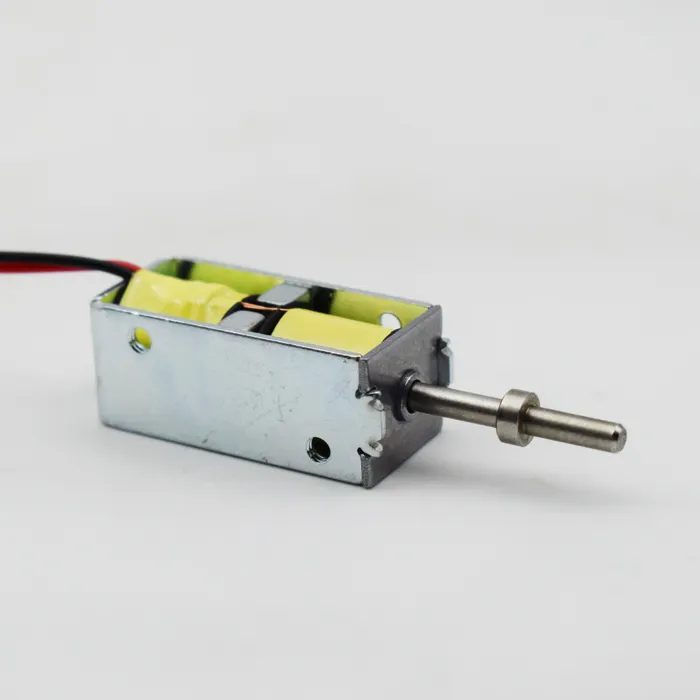
4. Bistable Solenoid vs. Monostable Solenoid: Power Consumption
One of the most important differences between a Bistable Solenoid and Monostable Solenoid is how they use electrical energy.
A Monostable Solenoid may need continuous current when the actuator must remain in its energized position.
The approximate electrical power can be expressed as:
P = V × I
Continuous current means continuous electrical energy consumption and continuous heat generation in the coil.
A Bistable Solenoid normally uses electrical energy primarily during the transition between its two states.
Por exemplo:
Pulse → Move → Latch → Power OFF
If the actuator remains stationary for several minutes or hours, the coil does not normally need to remain energized.
This can provide significant system-level advantages for applications with low switching frequency.
| Power Consideration | Bistable Solenoid | Monostable Solenoid |
|---|---|---|
| Energy during switching | Required | Required |
| Energy while holding energized state | Normally very low/negligible | Often continuously required |
| Coil heating during standby | Baixo | Potentially significant |
| Battery suitability | Strong advantage in suitable applications | Depends on duty cycle |
| Long holding period | Efficient | Can be inefficient |
| Frequent switching | Requires pulse-energy analysis | Often straightforward |
However, Bistable Solenoid does not automatically mean zero energy consumption.
If the actuator switches frequently, the cumulative pulse energy can still be significant.
Therefore, engineers should evaluate:
Energy per switching cycle × Number of switching cycles
rather than looking only at the nominal coil wattage.
5. Bistable Solenoid vs. Monostable Solenoid: Heat Generation
Power consumption and thermal performance are closely related.
A continuously energized Monostable Solenoid can generate significant heat because electrical power is continuously dissipated through the coil’s resistance.
Coil heating can affect:
- Resistência da bobina
- Electromagnetic force
- Insulation system
- Surrounding components
- Product temperature
- Long-term reliability
The problem becomes more important when the solenoid is installed inside a compact enclosure where heat cannot easily escape.
A Bistable Solenoid can reduce this particular thermal challenge because the coil generally receives power only during switching.
However, the switching pulse itself can generate a high instantaneous current.
Therefore, the correct engineering question is not simply:
“Which solenoid produces less heat?”
Instead, engineers should consider:
- Pulse energy
- Pulse duration
- Frequência de comutação
- Temperatura ambiente
- Thermal dissipation
- Resistência da bobina
- Enclosure conditions
- Required lifetime
For applications with long periods between switching events, a Bistable Solenoid can have a significant thermal advantage.
6. Bistable Solenoid vs. Monostable Solenoid: Holding Force and Position Retention
Position retention is another major difference.
A Monostable Solenoid generally depends on its mechanical return mechanism to determine the de-energized position.
Por exemplo:
Power OFF → Spring Return → Position A
A Bistable Solenoid is designed to retain either of its two states.
Por exemplo:
Position A → Pulse → Position B → Power OFF → Remains at B
The magnetic holding force must be sufficient to resist relevant external disturbances.
These may include:
- Vibração
- Shock
- Gravity
- External mechanical load
- Accidental impact
- System movement
At the same time, the holding force cannot simply be made as large as possible.
If magnetic holding force becomes excessively high, the switching coil may require greater energy to release the existing state.
This creates an important design balance:
Holding Force ↔ Release Force ↔ Switching Energy
Um profissional custom Bistable Solenoid manufacturer therefore needs to optimize the magnetic circuit rather than simply maximize magnetic strength.
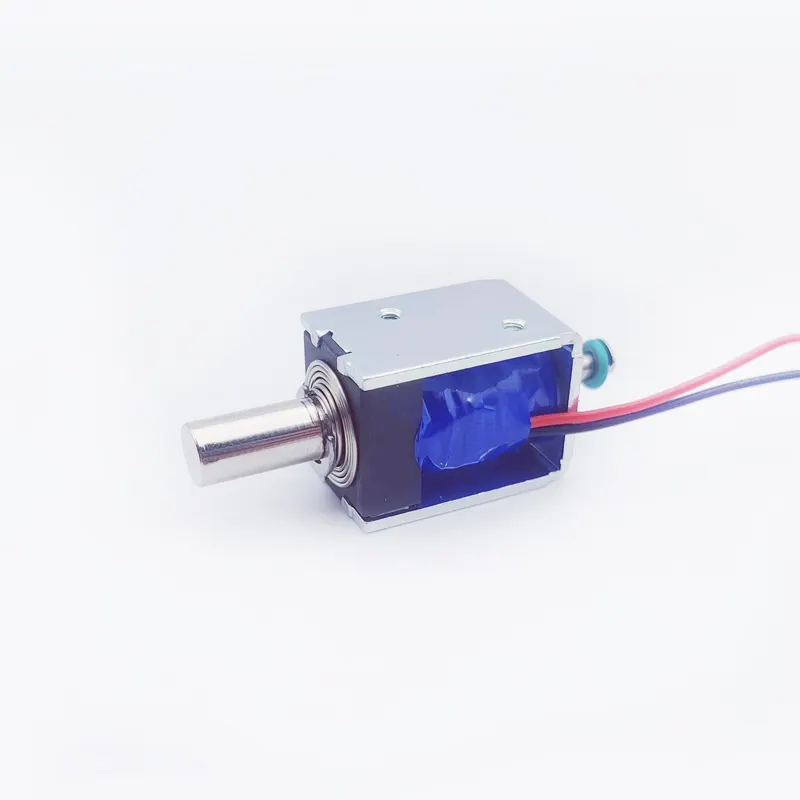
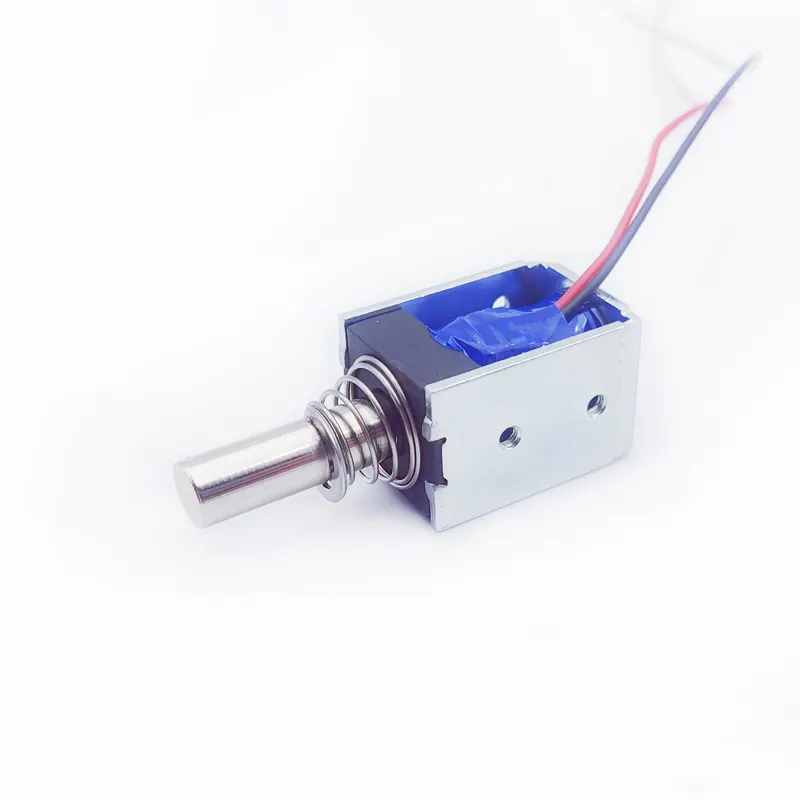
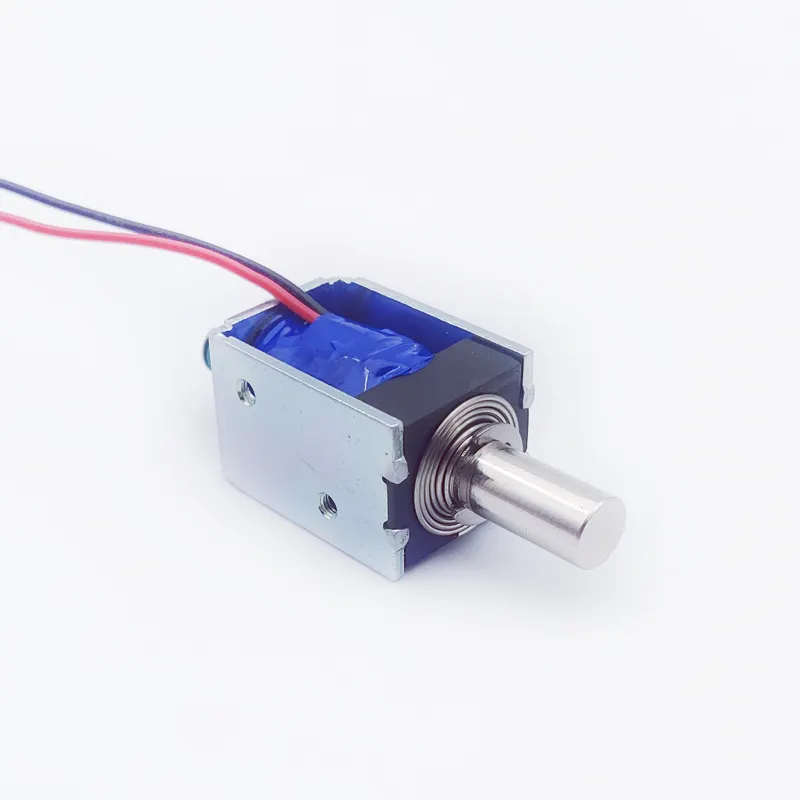
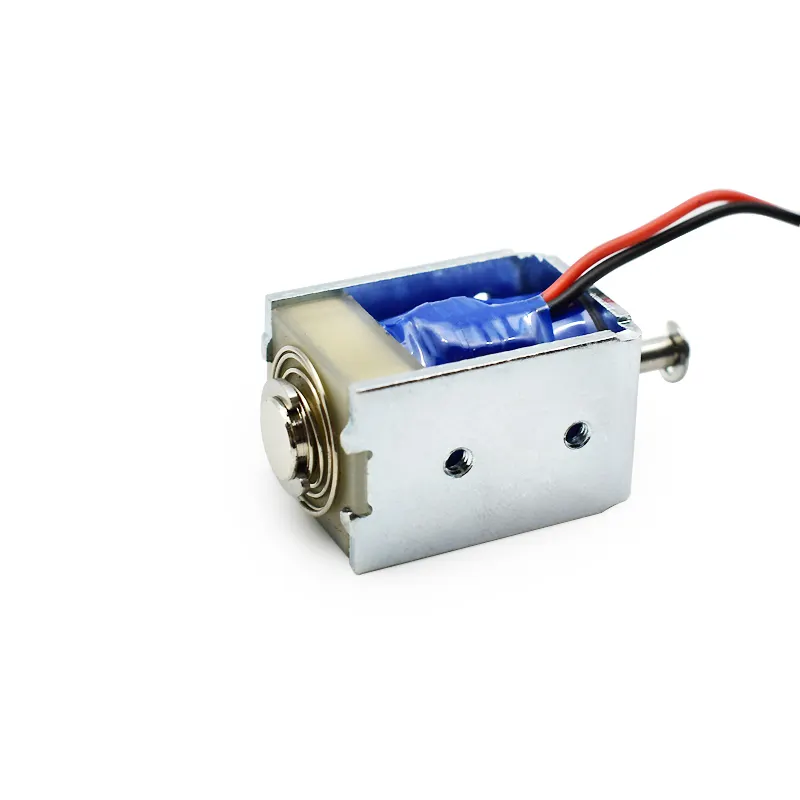
7. Bistable Solenoid vs. Monostable Solenoid: Control Circuit Differences
The control electronics can also be substantially different.
A Monostable Solenoid is often relatively simple to control.
A typical system can use:
Controller → Driver → Coil → ON/OFF
When the controller needs the actuator to move, it energizes the coil.
A Bistable Solenoid may require more sophisticated control.
Depending on the design, the control system may need to provide:
- Pulse-width control
- Polarity reversal
- H-bridge operation
- Current control
- Defined pulse timing
- Electrical protection
For example, one pulse polarity may move the actuator from A to B, while the opposite polarity may move it from B to A.
Therefore:
| Control Aspect | Bistable Solenoid | Monostable Solenoid |
|---|---|---|
| Basic ON/OFF control | Not always sufficient | Usually sufficient |
| Pulse control | Important | Less critical |
| Polarity reversal | May be required | Usually unnecessary |
| H-bridge | May be useful/required | Usually unnecessary |
| Controller complexity | Mais alto | Mais baixo |
| Energy management | Important | Relatively straightforward |
This is one of the main disadvantages of a Bistable Solenoid.
The actuator may save energy, but the overall system may require a more sophisticated driver.
Therefore, actuator selection should always consider the solenoid and control electronics together.
8. Bistable Solenoid vs. Monostable Solenoid: Force-Stroke Characteristics
Both Bistable and Monostable Solenoids require careful force-stroke analysis.
A common engineering mistake is to compare actuators using only a single maximum-force value.
Solenoid force changes with plunger position.
The effective force depends on:
- Entreferro
- Circuito magnético
- Coil current
- Material magnético
- Posição do êmbolo
- Magnetic saturation
- Força da mola
- External load
For a Bistable Solenoid, there is an additional consideration: the actuator must first overcome the magnetic holding force associated with the existing stable state.
A simplified force balance can be expressed as:
Net Force = Electromagnetic Force − Holding Force − Spring Force − Friction − External Load
The force profile therefore needs to be analyzed over the complete stroke.
For a Monostable Solenoid, the main concern may be whether electromagnetic force can overcome the return spring and external load throughout the required stroke.
For a Bistable Solenoid, engineers need to consider both:
- Release from the existing stable state
- Movement toward the new stable state
This makes magnetic and mechanical optimization particularly important.
9. Bistable Solenoid vs. Monostable Solenoid: Pros and Cons
Neither actuator architecture is universally better. Each has advantages and disadvantages.
Bistable Solenoid Advantages
1. Low standby power
The actuator normally does not need continuous power to maintain its state.
2. Reduced continuous coil heating
Because the coil is not continuously energized during position holding, average thermal loading can be lower in many applications.
3. Excellent battery compatibility
The low holding-power requirement can be valuable for battery-powered products.
4. Two-state retention
The actuator can maintain either of two stable positions.
5. Useful during power interruptions
Depending on the application, the actuator can retain its last state when electrical power is removed.
Bistable Solenoid Disadvantages
1. More complicated control
Pulse and polarity control may be required.
2. More complex magnetic design
The magnetic circuit must support reliable latching and release.
3. More demanding system integration
The controller and driver must be matched to the actuator.
4. Switching reliability depends on multiple variables
Pulse voltage, pulse duration, temperature, friction, load, and magnetic holding force can all affect operation.
Monostable Solenoid Advantages
1. Simple control
Basic ON/OFF switching is often sufficient.
2. Simple operating principle
Electromagnetic actuation and spring return are easy to understand and integrate.
3. Natural default position
Power loss can automatically return the actuator to a predefined state.
4. Wide application range
Monostable solenoids are suitable for many conventional push-pull applications.
Monostable Solenoid Disadvantages
1. Continuous power may be required
Long holding periods can consume substantial energy.
2. Continuous heat generation
An energized coil produces heat as long as current flows.
3. Battery operation can be more challenging
The suitability depends strongly on duty cycle and holding time.
10. When Should You Choose a Bistable Solenoid?
A Bistable Solenoid is particularly appropriate when the application has several of the following characteristics:
- Two stable mechanical states are required.
- The actuator may remain in one state for a long period.
- Continuous holding power is undesirable.
- Battery operation is important.
- Standby energy consumption must be minimized.
- Continuous coil heating is undesirable.
- The system needs to retain its last state after power is removed.
- Switching frequency is relatively low or controlled.
Typical applications include:
Smart Locks
A lock may need only two states: locked and unlocked. Continuous coil power is generally unnecessary.
Battery-Powered Metering Equipment
The actuator may switch a mechanism occasionally while spending most of its life in a stationary state.
Certain Valve Systems
A valve can remain open or closed without continuously powering the electromagnetic coil, depending on the valve architecture.
Vending and Dispensing Equipment
A short pulse can activate a mechanical function without requiring continuous energization.
Industrial Control
Two-position mechanical switching or locking can benefit from bistable operation.
Portable Equipment
Low standby energy can be important when battery capacity is limited.
11. When Should You Choose a Monostable Solenoid?
A Monostable Solenoid can be a better fit when the application requires a simple default position and straightforward control.
It is particularly appropriate when:
- The actuator should automatically return after power is removed.
- Continuous operation is short.
- Holding time is limited.
- A simple control circuit is preferred.
- The application already includes a return spring.
- The mechanism requires a defined fail-return behavior.
- Power consumption during holding is not a major concern.
For example, consider a machine that needs to push a component for 200 milliseconds and then automatically release it.
A Monostable Solenoid can provide a very straightforward solution:
Energize → Push → De-energize → Spring Return
There may be little benefit in adding the additional magnetic latching architecture of a Bistable Solenoid.
This is an important engineering principle:
The lowest-power actuator is not automatically the most appropriate actuator.
The correct actuator is the one that best matches the complete mechanical and electrical requirements of the system.
12. Bistable Solenoid vs. Monostable Solenoid: Application Selection Table
The following table provides a practical engineering framework for selecting between the two architectures.
| Application Requirement | Bistable Solenoid | Monostable Solenoid |
|---|---|---|
| Two stable positions | Excellent fit | Usually requires additional mechanism |
| Continuous holding | Generally unnecessary | Often required |
| Low standby power | Strong fit | Less advantageous |
| Battery-powered system | Often advantageous | Depends on duty cycle |
| Simple ON/OFF control | Less suitable | Strong fit |
| Automatic return after power loss | Depends on design | Strong fit |
| Long holding period | Advantageous | Can create heat/power consumption |
| Short actuation pulse | Suitable | Suitable |
| Infrequent switching | Particularly suitable | Suitable |
| Very frequent switching | Requires pulse-energy analysis | Requires duty-cycle analysis |
| Need to remember last state | Suitable | Usually not inherent |
| Simple fail-return mechanism | Less natural | Often advantageous |
This table should be treated as an initial engineering guide rather than a universal rule.
The final selection should be based on actual force, stroke, voltage, load, environmental, and lifetime requirements.

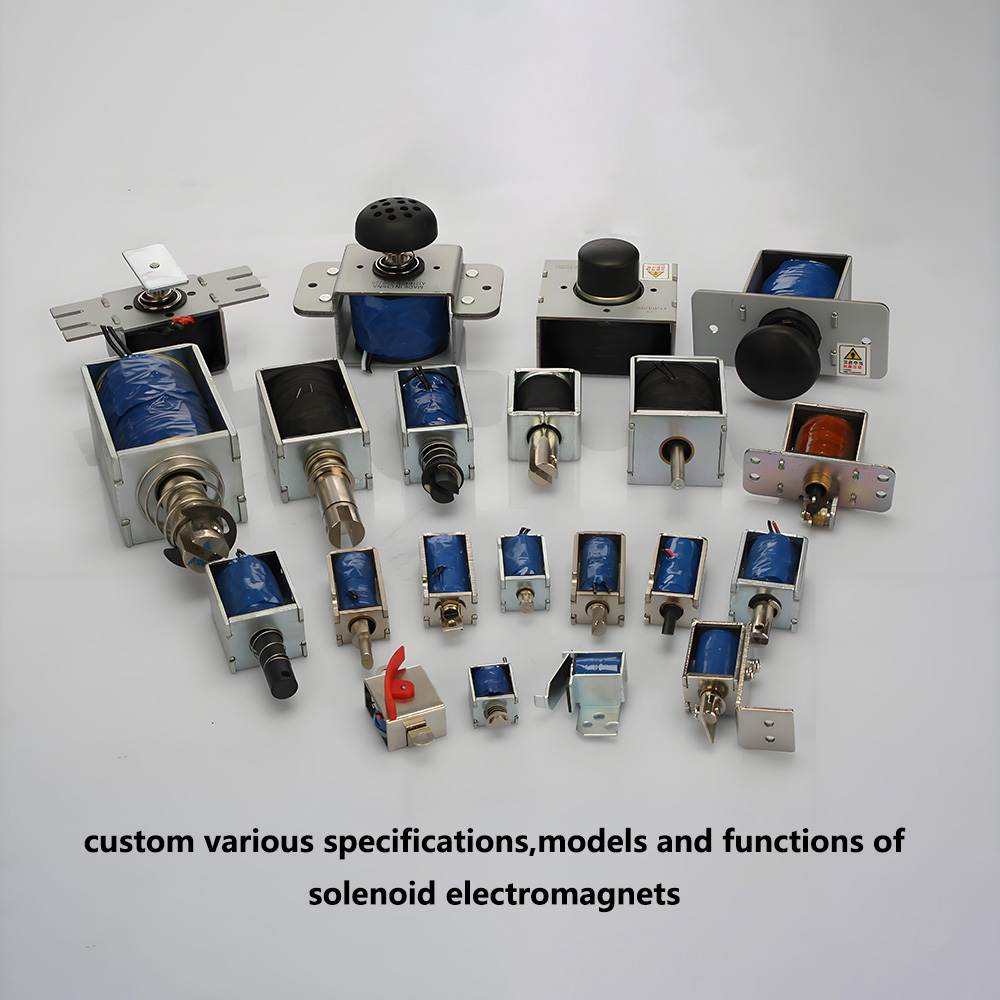
13. Custom Bistable Solenoid vs. Standard Monostable Solenoid: Why Customization Matters
Many OEM applications cannot be solved effectively by selecting a standard catalog solenoid.
The available installation space may be limited.
The customer may require a specific:
- Derrame
- Força
- Tensão
- Pulse width
- Holding force
- Plunger geometry
- Configuração de montagem
- Connector
- Habitação
- Força da mola
- Operating temperature
- Lifetime
This is where a custom Bistable Solenoid manufacturer can provide value.
For example, an OEM may need a compact actuator that can:
- Fit inside a small enclosure
- Move 4 mm
- Switch between two stable positions
- Operate from a battery
- Consume little standby power
- Withstand vibration
- Maintain its state when power is removed
Simply selecting a conventional Monostable Solenoid may not satisfy all these requirements.
A custom Bistable Solenoid can instead be developed around the complete application.
The manufacturer can optimize:
Magnetic Circuit + Coil + Plunger + Permanent Magnet + Air Gap + Spring + Housing + Control Requirements
This integrated approach is particularly important when the solenoid is a critical part of the customer’s final product.
14. How a Professional Bistable Solenoid Factory Controls Performance
For OEM production, actuator performance depends not only on the design but also on manufacturing consistency.
Um profissional Bistable Solenoid factory should control the key variables that influence electromagnetic and mechanical performance.
Magnetic Components
Material properties, dimensions, surface condition, and magnetic characteristics can influence the final magnetic circuit.
Coil Manufacturing
Os parâmetros importantes incluem:
- diâmetro do fio
- Number of turns
- Resistência
- Winding consistency
- Insulation
- Lead connections
Plunger Manufacturing
The plunger’s:
- Diâmetro
- Length
- Straightness
- Surface finish
- Material
- Geometry
can influence friction and magnetic performance.
Montagem
The relative position of the plunger, magnet, yoke, coil, and housing affects the final magnetic circuit.
Functional Testing
Depending on the product, testing may include:
- Resistência da bobina
- Tensão de operação
- Switching function
- Pulse response
- Força
- Derrame
- Holding force
- Release force
For higher-demand applications, reliability and environmental testing may also be appropriate.
This is why choosing a China Bistable Solenoid manufacturer should involve evaluating engineering capability and manufacturing control—not simply comparing unit prices.
15. SF: Your Custom Bistable Solenoid Manufacturer
SF is a professional customized electromagnet manufacturer with more than 10 years of experience in electromagnetic product manufacturing.
Our experienced engineering team works with customers to develop customized electromagnetic solutions according to specific mechanical, electrical, and application requirements.
SF operates a 6,000 m² factory, providing manufacturing capacity for customized electromagnets and solenoids.
We have helped many brand customers customize different types of electromagnets and have exported products to more than 60 countries and regions.
For customers developing a Bistable Solenoid application, our engineering approach focuses on the relationship between:
Application Requirements → Magnetic Circuit → Coil → Plunger → Latching Mechanism → Mechanical Load → Pulse Control → Manufacturing Consistency
Rather than treating the solenoid as an isolated component, the objective is to develop an actuator that works reliably within the customer’s complete product.
Typical Custom Bistable Solenoid Parameters
| Parâmetro | Customization Consideration |
|---|---|
| Derrame | Match the required mechanical travel |
| Força | Optimize according to load and position |
| Coil voltage | Match the customer’s power system |
| Pulse width | Establish reliable switching |
| Resistência da bobina | Balance current and thermal requirements |
| Holding force | Maintain the required stable state |
| Release force | Ensure reliable state transition |
| Desentupidor | Customize geometry and interface |
| Magnet | Optimize latching characteristics |
| Habitação | Match available installation space |
| Montagem | Customize holes, brackets, threads, etc. |
| Connector | Match the customer’s wiring system |
| Environment | Consider temperature, humidity, vibration, etc. |
| Lifetime | Validate against application cycle requirements |
For customers searching for a custom Bistable Solenoid manufacturer, Bistable Solenoid factory, ou China Bistable Solenoid manufacturer, the most important question is whether the supplier can translate the application requirements into a stable electromagnetic design and then reproduce that design consistently in production.
Bistable Solenoid vs. Monostable Solenoid: Frequently Asked Questions
What is the main difference between a Bistable Solenoid and a Monostable Solenoid?
A Bistable Solenoid has two stable positions and normally uses electrical pulses to switch between them. A Monostable Solenoid typically has one stable position and uses electromagnetic force to move to another position while energized, with a spring or other force usually returning it after power is removed.
Which solenoid consumes less power?
A Bistable Solenoid can have much lower average energy consumption when the actuator spends long periods holding a position because continuous coil energization is generally unnecessary. Actual energy consumption depends on switching frequency and pulse characteristics.
Is a Bistable Solenoid better for battery-powered equipment?
It can be particularly suitable for battery-powered equipment when the actuator changes state infrequently and must remain in position for long periods.
Is a Monostable Solenoid easier to control?
Generally, yes. A conventional Monostable Solenoid can often be controlled with straightforward ON/OFF switching, while a Bistable Solenoid may require pulse timing and, depending on its design, polarity reversal.
Does a Bistable Solenoid return to its original position when power is removed?
Normally, no. Its defining characteristic is that it can retain one of its two stable states after the switching pulse ends. However, the exact behavior depends on the actuator’s magnetic and mechanical architecture.
Which solenoid is better for automatic return?
A Monostable Solenoid is often suitable when the mechanism needs to return to a default position after power is removed.
Can a Bistable Solenoid be customized?
Yes. A professional custom Bistable Solenoid manufacturer can customize the magnetic circuit, coil, stroke, plunger, holding force, mounting structure, housing, electrical interface, and other parameters.
Can SF manufacture custom Bistable Solenoids?
SF specializes in customized electromagnet manufacturing and can develop solenoid solutions according to customer application requirements.
Bistable Solenoid vs. Monostable Solenoid
The difference between a Bistable Solenoid and a Monostable Solenoid is fundamentally a difference in how the actuator manages its mechanical states and electrical energy.
A Bistable Solenoid provides two stable positions and normally requires electrical energy primarily when changing states. This makes it particularly attractive for applications requiring low standby power, battery operation, long holding periods, and state retention without continuous coil energization.
A Monostable Solenoid normally provides one stable position and one energized position. It is often simpler to control and is particularly useful when the mechanism needs a defined return position after power is removed.
The comparison can be summarized as:
| Key Factor | Bistable Solenoid | Monostable Solenoid |
|---|---|---|
| Two-state retention | ✓ | Usually not inherent |
| Low standby power | ✓ | Depends on application |
| Continuous holding | Usually unnecessary | Often required |
| Controle simples | More complex | ✓ |
| Battery applications | Often advantageous | Application-dependent |
| Automatic return | Design-dependent | ✓ |
| Long holding periods | Strong advantage | Potentially less efficient |
| System complexity | Mais alto | Mais baixo |
| Magnetic design complexity | Mais alto | Generally lower |
Therefore, neither technology is universally superior.
The correct choice depends on what the final product needs to accomplish.
If the application requires two stable positions, low standby energy, and state retention, a Bistable Solenoid may be an appropriate architecture.
If the application requires simple electromagnetic actuation, straightforward ON/OFF control, and automatic return to a default position, a Monostable Solenoid may be more appropriate.
For OEM customers, the most reliable selection process begins with the actual application requirements: force, stroke, load, voltage, pulse characteristics, operating temperature, switching frequency, lifetime, installation dimensions, and required behavior after power loss.
Um experiente custom Bistable Solenoid manufacturer can then optimize the magnetic circuit, coil, plunger, permanent magnet, mechanical structure, and manufacturing process around those requirements.
With more than 10 years of customized electromagnet manufacturing experience, an experienced engineering team, a 6,000 m² factory, customized manufacturing capabilities, and products exported to more than 60 countries and regions, SF provides customized electromagnetic solutions for OEM and brand customers.
Ultimately, choosing between a Bistable Solenoid and a Monostable Solenoid is not simply a choice between two product names. It is a decision about how the entire product should convert electrical energy into mechanical movement, how it should behave when power is removed, and how efficiently it should maintain its required mechanical state.
Personalize todos os tipos de eletroímãs, entre em contato com a fábrica de eletroímãs SF whatsapp +86 189 0261 1680